

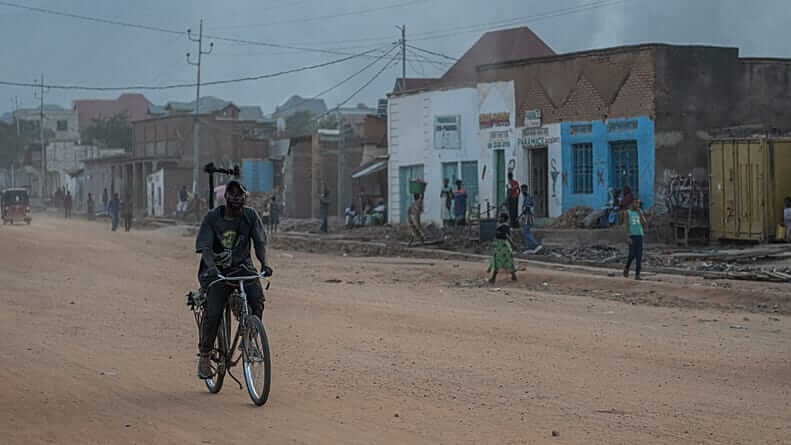
UVIRA, Democratic Republic of Congo — The people of Uvira are once again caught in a climate of fear and uncertainty after the M23 rebel movement announced it would withdraw from the city and hand over responsibility to the international community. The announcement, made late last week, has been met with skepticism by residents who have heard similar promises before, only to see fighting continue in their neighborhoods.
A Withdrawal in Name Only?
In its statement, the M23 said it would relinquish all security responsibilities in Uvira and called for the deployment of a neutral international force to protect civilians and strategic infrastructure. Yet residents remain unconvinced.
“We heard that they are going to leave, but we don’t know if they have really left or if they will leave, because this is not the first time they announce it; this will be the second time,” said local resident Mukuninwa Assumani Ruffin.
Another resident, Muzingwa Ramazani, voiced the community’s deepest concern: “What worries us here in Uvira is our security. How are we going to live after the M23 leaves?”
Fighting Despite Announcements
Despite the rebels’ declaration, clashes have continued. Reports indicate fighting between Wazalendo militias and M23 forces around Uvira. On Thursday, the rebels reportedly seized control of Lemera, a strategic town in Uvira territory, despite repeated calls for a ceasefire.
Civil society actor Ghislain Baraiga Kabamba explained: “They are still fighting, especially in the south‑south parts of Uvira, in Makobola and other localities, and this worries us. But if they do withdraw, it will be a good thing.”
Ongoing Security Threats
In a letter to UN Secretary‑General António Guterres, M23’s political coordinator Corneille Nangaa warned of persistent threats from actors not signatory to peace agreements. He cited the Burundian army, the FDLR (Democratic Forces for the Liberation of Rwanda), and Wazalendo militias aligned with the Congolese army (FARDC) as destabilizing forces.
Analysts argue that international mediation has failed to adequately address these complexities. Hubert Masomeko, an independent researcher at the Center for Research on Democracy and Development in Africa (CREDDA), criticized American mediation efforts: “The American mediation, which obtained the withdrawal of AFC/M23 from the city of Uvira, did not take steps to verify not only the withdrawal of the M23 from Uvira, but also the transitional period. Security issues regarding the city of Uvira were unfortunately not taken into account.”
Silence from Kinshasa and MONUSCO
So far, neither the Congolese government nor the United Nations Organization Stabilization Mission in the DRC (MONUSCO) has officially responded to M23’s latest announcement. Their silence has left civilians anxious about the future of the peace process and their immediate safety.
Historical Context
The M23 rebellion has been one of the most destabilizing forces in eastern Congo over the past decade. Emerging from former Tutsi‑dominated rebel factions, the group has repeatedly clashed with the Congolese army and rival militias. Despite peace agreements, M23 has often resurfaced, exploiting weak governance and regional rivalries.
Uvira, located near the border with Burundi, is strategically important. Its control offers access to trade routes and influence over cross‑border dynamics. For residents, however, the city’s importance has translated into repeated cycles of violence, displacement, and insecurity.
Regional Dimensions
The crisis in Uvira cannot be separated from broader regional tensions. Burundi’s involvement, accusations against Rwanda, and the presence of multiple armed groups complicate any peace effort. The exclusion of Eritrea from the Pretoria Agreement and the fragile trust between Kinshasa and Kigali further muddy the waters.
International actors, including the United States and African Union, have attempted mediation, but critics argue these efforts lack enforcement mechanisms. Without neutral forces on the ground, announcements of withdrawal risk becoming symbolic gestures rather than substantive steps toward peace.
Outlook
For Uvira’s residents, the uncertainty is suffocating. Each announcement of withdrawal raises hopes, only to be dashed by renewed fighting. The absence of clear communication from both the Congolese government and MONUSCO deepens mistrust.
The international community faces a pressing challenge: to ensure that commitments made by armed groups are verified and enforced, while protecting civilians caught in the crossfire. Without stronger measures, Uvira risks remaining a city trapped between promises of peace and the reality of war.