

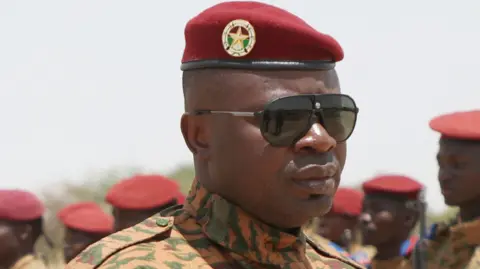
OUAGADOUGOU, Burkina Faso — Former Burkinabè leader Paul‑Henri Sandaogo Damiba has been extradited from Togo to Burkina Faso after authorities accused him of plotting to assassinate his successor, Captain Ibrahim Traoré. The move marks a dramatic escalation in the country’s turbulent political landscape, where coups, conspiracies, and insurgency have defined recent years.
The Extradition
According to Togo’s justice ministry, Damiba was handed over to Burkinabè authorities on Saturday. As part of the deal, Ouagadougou pledged to guarantee Damiba’s physical integrity, dignity, and fair‑trial rights, and to exclude the death penalty from any proceedings.
Damiba, who seized power in January 2022 by overthrowing elected president Roch Marc Christian Kaboré, ruled for just eight months before being ousted by Traoré, then a 34‑year‑old artillery officer. His short presidency was marked by promises to restore security against jihadist violence, but his failure to deliver led to his downfall.
The Charges
Burkina Faso’s military government has leveled a series of charges against Damiba, including:
- Criminal embezzlement of public funds
- Illicit enrichment and corruption
- Aggravated receiving of stolen goods
- Money laundering
Most serious, however, are allegations that Damiba masterminded a murder plot against Traoré. Earlier this month, Security Minister Mahamadou Sana announced on state television that security forces had foiled a series of targeted assassinations aimed at destabilizing the state, including what he described as the planned “neutralisation” of Traoré.
Officials in Ouagadougou have repeatedly accused Damiba of orchestrating plots from exile. In late 2024, he was publicly named as the head of what authorities called the “military wing” of a broader conspiracy.
A History of Coups and Rivalries in Burkina Faso
Damiba’s trajectory reflects the volatility of Burkina Faso’s politics. His coup in 2022 was initially welcomed by some citizens frustrated with Kaboré’s inability to stem jihadist attacks. Yet his own rule quickly faltered, as violence spread and confidence eroded.
Traoré’s subsequent takeover in September 2022 ushered in a new era of assertive nationalism. The junta expelled French forces, distanced itself from Western partners, and reinstated the death penalty, including for crimes of high treason.
While Traoré has consolidated power, Burkina Faso remains mired in one of the world’s most severe security crises. Militants linked to al‑Qaeda and the Islamic State continue to launch attacks across vast swathes of the country, displacing millions and undermining state authority.
Regional and International Dimensions
Damiba’s extradition also highlights the role of neighboring states in Burkina Faso’s internal struggles. Togo’s cooperation in handing him over reflects regional efforts to contain instability, though it also raises questions about the balance between justice and political expediency.
International observers are watching closely. Human rights groups have expressed concern about the reinstatement of the death penalty and the junta’s heavy‑handed tactics. The promise to spare Damiba from capital punishment may be aimed at reassuring both domestic critics and foreign partners.
Implications for Stability
The return of Damiba under arrest is expected to escalate tensions within Burkina Faso’s military and political establishment. Repeated accusations of plots, combined with widening divisions among armed factions, risk undermining the junta’s grip on power.
Political analysts warn that internal rivalries could weaken the government’s ability to confront jihadist insurgents. “The danger is that the military becomes consumed by infighting, while the insurgency continues unchecked,” one observer noted.
Outlook
Damiba’s fate will likely be decided in the coming months as he faces trial on charges ranging from corruption to attempted assassination. For Traoré’s junta, the case is both a test of its commitment to justice and a demonstration of its determination to neutralize rivals.
Yet the broader challenge remains: restoring stability in a country battered by violence, displacement, and political upheaval. Whether Damiba’s extradition strengthens the government or deepens divisions will shape Burkina Faso’s trajectory in the years ahead.