

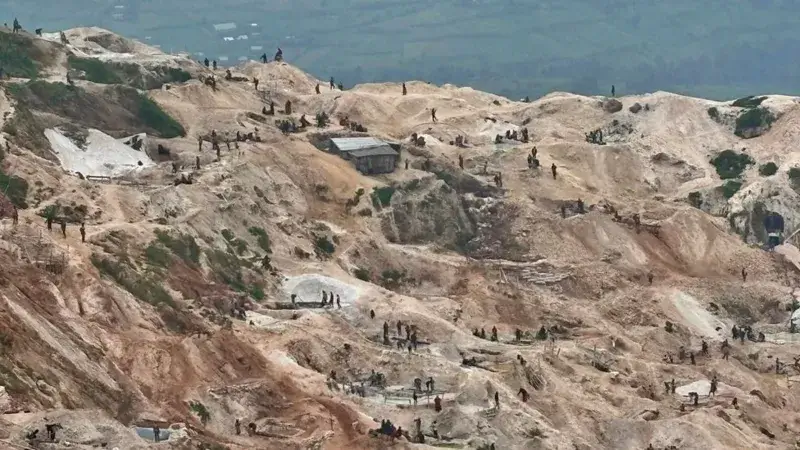
RUBAYA, DR CONGO — More than 200 people have been killed in a devastating mine collapse in eastern Democratic Republic of Congo (DRC), underscoring the perilous conditions faced by artisanal miners and the complex geopolitics surrounding the country’s mineral wealth.
The Collapse
The disaster struck on Wednesday in the town of Rubaya, North Kivu province, after days of heavy rains weakened the soil. Witnesses say women and children were among those mining coltan, a mineral critical for the production of smartphones, computers, and other electronics.
Lumumba Kambere Muyisa, spokesman for the rebel governor of North Kivu, confirmed the collapse but initially said the death toll was unclear. By Friday, rebel authorities acknowledged that more than 200 lives had been lost. Around 20 survivors are receiving treatment in hospital.
A former supervisor told the BBC that the mine had been poorly maintained, with fragile soil and unsafe pits making accidents inevitable. Rescue efforts were hampered by the lack of equipment and organization.
Human Toll
Families across Rubaya are mourning. One source, whose cousin died in the landslide, described him as “courageous” and “ambitious,” focused on providing for his wife and two children. “I didn’t believe he could pass away in such circumstances,” the relative said, recalling the painful moment when his body was finally discovered.
Artisanal miners — those not formally employed by companies — are particularly vulnerable. Driven by poverty, they often work in dangerous conditions without protective gear or safety oversight.
Rebel Control and Responsibility
Rubaya’s mines have been under the control of M23 rebels since 2024. The group, accused by international observers of being backed by Rwanda, has imposed taxes on mining operations and profited from the sector. Rwanda has consistently denied supporting M23, but UN experts say there is evidence that minerals from DRC are being exported through Rwanda.
Congolese authorities condemned the collapse, blaming rebels for allowing illegal mining without enforcing safety standards. They noted that mining in the area had been banned last year, but rebels ignored the prohibition.
Governor Erasto Bahati Musanga, appointed by M23, visited survivors on Friday, but the gesture did little to ease anger over the rebels’ role in the tragedy.
Geopolitical Dimensions
The collapse highlights the intersection of local tragedy and global demand. Rubaya’s mines hold about 15% of the world’s coltan supply and half of DRC’s deposits. Coltan contains tantalum, used to produce high‑performance capacitors essential for modern electronics.
This makes Rubaya a focal point of international interest — and exploitation. The Congolese government accused Rwanda of using M23 to loot minerals, describing the situation as “a structured system of illegal exploitation of natural resources.”
Although Rwanda denies the charge, the UN has documented evidence of minerals being funneled through its territory. The collapse thus underscores not only the human cost of unsafe mining but also the broader geopolitical struggle over control of DRC’s resources.
A Pattern of Disasters
Mine collapses are tragically common in DRC, both in rebel‑held and government‑controlled areas. Poor maintenance, fragile soil, and heavy rains combine to create deadly conditions. Artisanal miners, often including women and children, are disproportionately affected.
In July 2025, a BBC team visiting Rubaya observed miners digging manually in dangerous pits, with little oversight or safety infrastructure. The conditions they described foreshadowed the disaster that has now claimed hundreds of lives.
Outlook
The Rubaya collapse is one of the deadliest mining accidents in recent years, and it has reignited debate about the governance of DRC’s mineral wealth. For local communities, the tragedy is a reminder of the risks they face daily in pursuit of survival. For the Congolese government, it is further evidence of the destabilizing role of rebel groups and the alleged involvement of external actors.
Globally, the incident raises uncomfortable questions about the supply chains behind everyday electronics. As demand for coltan and other minerals grows, the human cost borne by miners in DRC becomes harder to ignore.
For now, Rubaya mourns its dead, while survivors struggle to recover. But unless safety standards are enforced and governance strengthened, the cycle of exploitation and tragedy is likely to continue.