

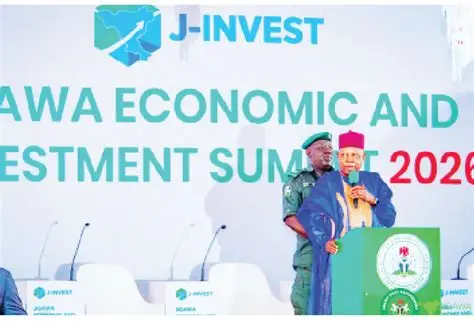
Jigawa State has taken a significant step in showcasing its vast economic potential, unveiling a wealth of investment opportunities at the highly successful two-day Jigawa Economic and Investment Summit (J-INVEST 2026).
Held in the state capital, Dutse, the summit attracted hundreds of local and international investors, business leaders, and policymakers, signaling a new phase of economic transformation for the Northwestern state.
With its abundant natural resources, peaceful environment, and focused leadership, Jigawa is positioning itself as a prime investment destination in Nigeria. Despite these advantages, investment inflows into the state have historically remained below expectations, largely due to poor documentation of opportunities, limited promotion, and bureaucratic bottlenecks that discouraged potential investors.
Governor Malam Umar Namadi, through his administration’s 12-point development agenda and the “Greater Jigawa” vision, has introduced a comprehensive strategy to address these challenges. The J-INVEST 2026 Summit represents a deliberate effort to expand economic activities, following extensive consultations with academic institutions, research bodies, and private sector experts to properly document and package investment opportunities for global investors.
Declaring the summit open, Vice President Senator Kashim Shettima noted that the administration of President Bola Ahmed Tinubu has implemented far-reaching reforms to create a more business-friendly environment across Nigeria. He emphasized that Jigawa State is already leveraging these reforms to attract investment.
Through initiatives such as the Presidential Enabling Business Environment Council (PEBEC) and the Business Facilitation Act, the federal government has streamlined business registration processes, reduced costs, and improved transparency and efficiency within public institutions.
The Vice President also highlighted key economic reforms, including the unification and liberalization of the foreign exchange market, which has eliminated long-standing distortions, and the Electricity Act 2023, which empowers states to generate, transmit, and distribute electricity—an important development for industrial growth.
After reviewing Jigawa’s investment portfolio, he urged both local and international investors to take advantage of the state’s opportunities, noting that sectors such as agriculture, mining, commerce, and industry offer strong prospects for high returns.
He commended the ongoing transformation in Jigawa under Governor Namadi, particularly in agriculture, infrastructure development, and road construction, describing these efforts as vital for sustainable investment.
Governor Namadi outlined numerous opportunities across key sectors and assured investors of government support through tax incentives, simplified documentation, and timely approvals.
Jigawa boasts over 24,700 square kilometers of fertile agricultural land, including more than 411,000 hectares of Fadama wetlands suitable for year-round farming. The state is Nigeria’s leading producer of sesame and hibiscus and ranks among the top producers of wheat, rice, sorghum, millet, and tomatoes. With irrigation infrastructure, a youthful workforce, and strategic access to markets in northern Nigeria and the Niger Republic, the agricultural sector presents enormous potential.
The Gagarawa Industrial Park, a 170.8-hectare multi-use facility, is emerging as a regional manufacturing hub, with several plots already allocated to companies affiliated with the Manufacturers Association of Nigeria (MAN). The near-completion of the Dangote Rice Mill, expected to process 350 tonnes of rice daily, further underscores the state’s industrial growth, alongside opportunities in fertilizer blending, textile production, and food processing.
Jigawa is also rich in solid minerals, with deposits of more than ten commercially viable minerals across the Chad Formation and Basement Complex. These resources present significant opportunities for mining and export.
In the energy sector, the proposed 1GW solar plant in Gwiwa Local Government Area, alongside partnerships with the Rural Electrification Agency for solar mini-grids, is positioning the state as a hub for renewable energy investment. The state’s Off-Grid Solar Policy (2022–2030) and ongoing solar projects expected to generate about seven megawatts further reinforce this commitment.
Infrastructure development has also been a priority. Jigawa has over 3,600 kilometers of paved roads connecting major towns and communities. The upgrade of Dutse International Airport to cargo status and the ongoing Lagos–Kano–Maradi railway project, with a spur to Dutse, are expected to significantly enhance logistics and reduce transportation costs.
The livestock sector also offers strong investment potential, with an estimated population of 3.6 million cattle, 5.6 million sheep, and 6.6 million goats, creating opportunities in livestock production and processing.
In the past three years, Jigawa has facilitated 64 investment projects across agriculture, renewable energy, and manufacturing, worth several billions of naira. The state’s 2026 budget allocates N693 billion to capital projects, with over N396 billion dedicated to economic sectors. Additionally, about 13,000 hectares of land have been allocated to investors since 2024 under the Framework for Responsible and Inclusive Land-Intensive Agriculture (FRILIA).
Experts at the summit highlighted the strategic importance of the Maigatari Border Free Zone as a gateway to markets in Niger, Chad, and northern Cameroon. They noted that the development of an inland dry port would further boost trade and competitiveness in the region.
Governor Namadi reaffirmed the state’s commitment to supporting and protecting investors, emphasizing that Jigawa remains one of Nigeria’s most peaceful states with vast economic opportunities. He assured both participants and observers that the government would provide necessary incentives, facilitate documentation, and ensure timely approvals for investment projects.
Jigawa was recently ranked as the second easiest state to do business in Nigeria in the Sub-national Ease of Doing Business Survey 2023 conducted by PEBEC.
The message from Jigawa is clear: the state is open for business, ready for partnerships, and committed to delivering sustainable returns on investment.
On the final day of the summit, an investment pipeline worth $140 million was recorded across priority projects. These include an $85 million Jigawa Renewable Energy Project, a $42 million Dutse International Hotel and Convention Centre, and a $12.4 million modern livestock development project.