

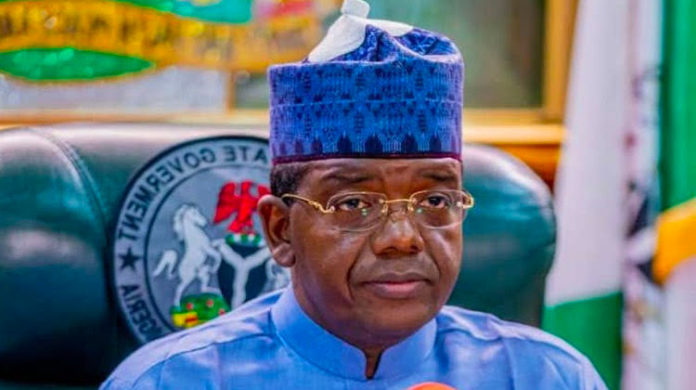
Minister of State for Defence, Bello Matawalle, has unveiled the “Tinubu Again” movement, a political initiative aimed at mobilising support for President Bola Ahmed Tinubu ahead of the 2027 general elections.
The movement, according to its promoters, is targeting about 20 million voters as part of a broader campaign to secure Tinubu’s re-election and strengthen support for the administration across Nigeria.
The development signals an intensification of political mobilisation ahead of the 2027 presidential contest, with supporters of the President increasingly organising grassroots structures to promote his policies and seek a second term.
Matawalle launches support movement
Matawalle, a prominent member of the All Progressives Congress (APC), said the “Tinubu Again” initiative would focus on mobilising Nigerians who support the President’s administration and believe his economic and development policies deserve another term.
The movement is expected to establish a broad network of supporters across states and local government areas, with particular emphasis on grassroots mobilisation.
Matawalle’s announcement comes as political activities surrounding the 2027 elections gradually intensify, with parties, politicians and support groups beginning to position themselves ahead of the electoral cycle.
Targeting 20 million voters
One of the major objectives announced by the organisers is the mobilisation of 20 million voters in support of Tinubu.
Achieving such a target would require an extensive grassroots campaign involving political organisers, community leaders, youth groups, women’s organisations and other support networks.
The movement is expected to use both conventional political structures and digital platforms to reach potential supporters.
Its promoters believe that a strong grassroots presence will be essential to translating public support into actual votes during the 2027 election.
Promoting Tinubu’s reforms
Supporters of the initiative are expected to make the President’s economic reforms a central component of their campaign.
Since assuming office, Tinubu has introduced a number of major policy changes, including the removal of the petrol subsidy and reforms to the foreign exchange market.
The administration has argued that the measures are necessary to stabilise the economy, attract investment and create conditions for long-term growth.
However, the reforms have also generated significant public debate because of their impact on the cost of living.
The “Tinubu Again” movement is therefore likely to face the challenge of convincing voters that the benefits of the administration’s policies will outweigh the immediate difficulties experienced by many households.
2027 political mobilisation gathers pace
Although the 2027 election is still ahead, political mobilisation has already begun across Nigeria.
Potential presidential contenders and political parties are increasingly engaging with supporters, while various groups are emerging to promote different political interests.
The launch of “Tinubu Again” adds another layer to the growing political activity surrounding the next presidential election.
Support groups can play an important role in elections by mobilising voters, raising awareness and promoting candidates outside the formal structures of political parties.
Grassroots support crucial
Nigeria’s electoral landscape makes grassroots mobilisation particularly important.
Presidential candidates require support across multiple regions and voter demographics to build a competitive national coalition.
The movement’s 20-million-voter target will therefore require organisers to establish a presence in communities across the country rather than concentrating solely on major cities.
Matawalle and other promoters will need to persuade voters on the basis of the administration’s record while addressing concerns over economic hardship, unemployment, insecurity and other issues affecting citizens.
Youth and women in focus
Young people are expected to constitute an important target group for the movement.
Nigeria has a large youth population, and young voters can significantly influence electoral outcomes.
The movement could therefore focus on issues such as employment, entrepreneurship, digital skills, education and access to economic opportunities as it seeks to attract younger Nigerians.
Women also represent a significant voting bloc and could feature prominently in the mobilisation strategy.
Defending the administration’s record
The political group is also expected to defend the Tinubu administration against criticism from opposition parties and other political actors.
The President’s supporters have argued that the administration inherited significant economic challenges and has introduced difficult reforms intended to address longstanding structural problems.
Opponents, however, have criticised the impact of those policies on ordinary Nigerians and questioned whether the reforms have produced sufficient improvements in living standards.
The 2027 campaign is likely to feature an intense debate over these competing assessments.
Opposition prepares for 2027
The emergence of the “Tinubu Again” movement also comes as opposition forces work to build alliances and develop strategies for challenging the APC.
Opposition parties are expected to focus on issues such as inflation, unemployment, insecurity, poverty and the cost of living as they seek to persuade voters to change political direction.
The APC and its support groups, meanwhile, will likely emphasise economic reforms, infrastructure projects, investment and other achievements of the Tinubu administration.
The resulting contest could make 2027 one of the most closely watched presidential elections in Nigeria’s recent political history.
Beyond slogans
For the “Tinubu Again” movement to achieve its ambitious target, political observers say mobilisation will have to go beyond slogans and rallies.
Voters are likely to demand clear explanations of how government policies have affected their daily lives and what a second Tinubu administration would do differently.
The movement will also need an effective organisational structure capable of converting supporters into registered voters and, ultimately, actual voters on election day.
Its success will depend on the credibility of its message and its ability to establish sustained engagement with communities.
Electoral process remains key
As political groups prepare for the 2027 election, attention will also remain focused on the electoral process itself.
The Independent National Electoral Commission (INEC) will be responsible for conducting the election, while political parties and candidates will be expected to comply with relevant electoral laws.
For support movements such as “Tinubu Again,” mobilisation efforts will need to operate within the legal framework governing political campaigns and elections.
Voter education and peaceful political participation will also be important as competition intensifies.
A major political test
The 2027 presidential election will provide a major test of the Tinubu administration’s popularity and the APC’s ability to retain power at the federal level.
The “Tinubu Again” movement’s decision to target 20 million voters demonstrates the scale of the mobilisation effort being contemplated by supporters of the President.
Whether the initiative can translate its ambitious target into measurable electoral support will depend on several factors, including the economy, security, public perception of government performance and the strength of the opposition.
For now, Matawalle’s initiative represents another clear indication that the race for 2027 is already taking shape.
As political parties and support groups intensify their activities, Nigerians are likely to witness a growing contest over policies, performance and competing visions for the country’s future.
The “Tinubu Again” movement has set an ambitious target. Its ability to mobilise 20 million voters could become an important component of the APC’s strategy as it seeks to secure President Tinubu another term in office in 2027.