

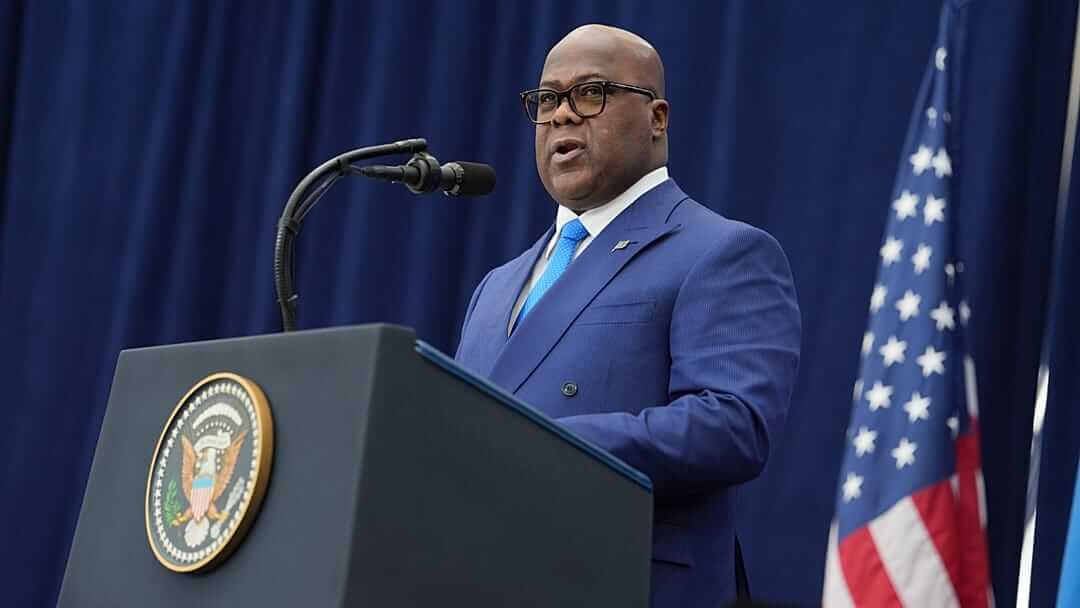
KINSHASA, DRC — Congolese President Félix Tshisekedi has reaffirmed his commitment to an inclusive national dialogue, but with clear pre‑conditions that reflect both the fragility of the country’s political environment and his determination to maintain institutional legitimacy. Speaking in a New Year’s address to the diplomatic corps in Kinshasa, Tshisekedi described national unity as “more than ever a fundamental requirement” amid ongoing conflict in the east of the country.
Background: Calls for Dialogue
The idea of an inter‑Congolese dialogue has been gaining traction in recent weeks. Sections of the opposition have demanded it, while Angolan President João Lourenço has promoted the initiative as a way to stabilize the DRC. The push comes as fighting continues between the Congolese army and M23 rebels, a group widely believed to be backed by Rwanda.
For Tshisekedi, dialogue is possible — but only under specific conditions. He stressed that any process must:
- Take place on Congolese soil.
- Be conducted under institutional control, not external mediation.
- Avoid questioning the legitimacy of elected institutions, including his own presidency.
- Respect existing court decisions, with no attempt to overturn judicial rulings.
Legitimacy and Opposition Challenges
Tshisekedi’s insistence on legitimacy is significant. His re‑election has been contested by parts of the opposition, who accuse him of mismanaging the country and question the credibility of the electoral process. By setting conditions, Tshisekedi is signaling that dialogue cannot be used as a platform to undermine his authority or the institutions elected by universal suffrage.
This stance may complicate efforts to bring opposition groups fully into the process, but it reflects the president’s determination to safeguard the constitutional order.
Justice and Accountability
Tshisekedi also emphasized that dialogue should not interfere with judicial proceedings. “Justice will follow its normal course with rigour, to the end, and without complacency, in order to honour the memory of those who have unjustly fallen as a result of the attack,” he said.
His remarks come in the wake of a landmark ruling against former president Joseph Kabila, who was sentenced to death in absentia in September by a military court. Kabila was convicted of war crimes, treason, and crimes against humanity, accused of backing the advance of M23 rebels in eastern Congo. He has denied any wrongdoing.
By linking dialogue to justice, Tshisekedi is underscoring that reconciliation cannot come at the expense of accountability for past crimes.
2026: A Decisive Year
Looking ahead, Tshisekedi declared that 2026 would be a decisive year for the DRC, centered on four priorities:
- Durable security in the east and restoration of state authority.
- Accelerated governance reforms to strengthen institutions.
- Economic transformation, leveraging Congo’s vast natural resources.
- Consolidation of national unity, through dialogue and inclusive policies.
These priorities reflect the dual challenge facing the DRC: addressing immediate security threats while laying the groundwork for long‑term stability and development.
Regional Dimensions
The DRC’s crisis is not confined within its borders. The conflict with M23 rebels has strained relations with Rwanda, while Angola’s mediation efforts highlight the regional stakes. The Great Lakes region has long been destabilized by cross‑border insurgencies, refugee flows, and competition over resources.
Tshisekedi’s insistence that dialogue remain under Congolese control may be seen as a rejection of external interference, but it also raises questions about how regional partners can contribute to peace without undermining sovereignty.
Outlook
The president’s conditions for dialogue set the stage for a complex political process. On one hand, they provide a framework that protects institutional legitimacy and judicial independence. On the other, they may limit the scope of dialogue, particularly if opposition groups feel excluded or constrained.
For the Congolese people, the stakes are high. Decades of conflict, corruption, and weak governance have left the country struggling to achieve stability. Tshisekedi’s vision for 2026 — combining security, reform, economic transformation, and unity — offers hope, but its success will depend on whether dialogue can bridge divides without eroding the foundations of the state.
As the DRC enters what Tshisekedi calls a decisive year, the challenge will be to balance inclusivity with legitimacy, reconciliation with justice, and sovereignty with regional cooperation.