

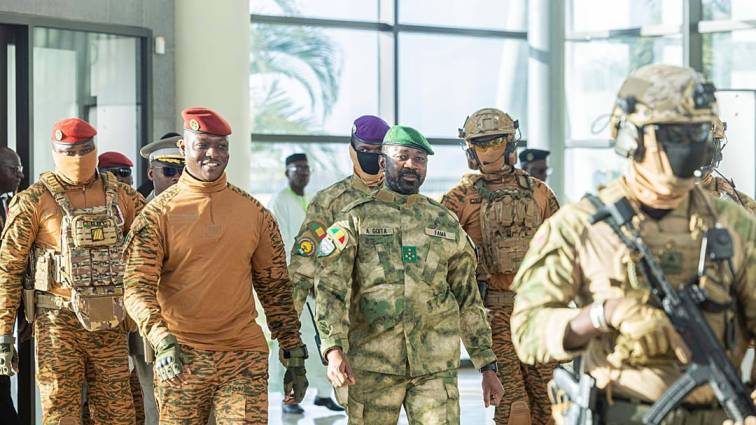
BAMAKO, Mali — The leaders of Mali, Niger, and Burkina Faso gathered in Bamako this week for the second Alliance of Sahel States (AES) summit, underscoring their determination to chart a path of regional autonomy and reduce reliance on the West African bloc ECOWAS.
Mali’s President Assimi Goïta welcomed Niger’s Abdourahamane Tchiani at Bamako’s airport on Monday, before both headed to the presidential palace. Burkina Faso’s Ibrahim Traoré joined the summit on Tuesday after a brief delay.
Key Outcomes of the Summit
- Joint Military Force: The three states formally announced the creation of a combined military force to tackle terrorism and insurgency across the Sahel, a region plagued by jihadist violence for over a decade.
- AES TV Broadcaster: Leaders launched a new Alliance of Sahel States television channel, aimed at countering disinformation and promoting the bloc’s narrative to regional and international audiences.
- Leadership Transition: A new head of the AES is expected to be named during the summit, succeeding Goïta, who was appointed president of the alliance last year.
Background
The AES was formed in 2023, following military coups in all three countries and subsequent fallout with Western partners. In 2024, Mali, Niger, and Burkina Faso formally withdrew from ECOWAS, accusing the bloc of imposing punitive sanctions and undermining their sovereignty.
Despite the withdrawal, ECOWAS has signaled openness to allowing the three states to retain certain privileges, particularly in trade. The countries remain members of the West African Economic and Monetary Union (UEMOA), which ensures free movement of goods among eight member states, including Senegal, Ivory Coast, and Benin.
Assertion of Autonomy
Beyond military and media initiatives, the AES states have introduced new travel documents for their citizens, further distancing themselves from ECOWAS frameworks. Analysts note that these moves reflect a broader effort to consolidate power internally while presenting a united front externally.
Regional Implications
The Sahel remains one of the world’s most volatile regions, with overlapping crises of terrorism, displacement, and food insecurity. The AES’s push for autonomy could reshape West African geopolitics, especially as the bloc strengthens ties with non‑Western partners such as Russia.