

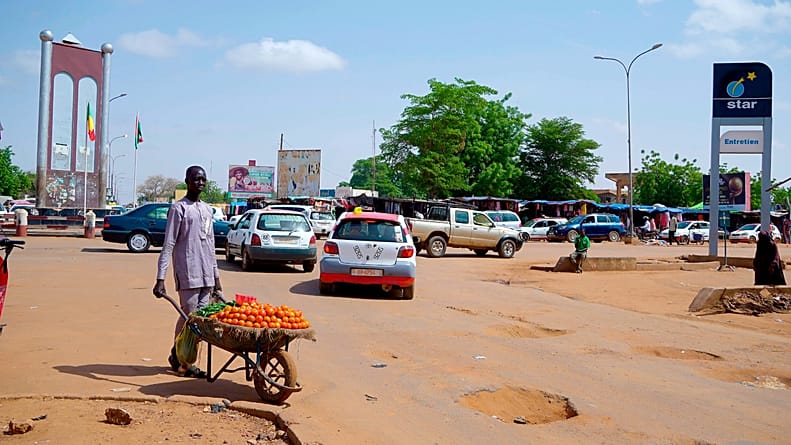
NIAMEY, Niger — Residents of Niger’s capital endured a terrifying night as hours of heavy gunfire and explosions erupted near Diori Hamani International Airport, raising fears of a possible jihadist attack. The incident, which began in the early hours of Thursday, left communities shaken and underscored the fragile security situation in the Sahel nation.
The Incident
Witnesses described sustained gunfire and multiple blasts that echoed across neighborhoods surrounding the airport. The shooting reportedly began after midnight and continued for several hours before subsiding.
By Thursday morning, authorities had yet to issue an official statement, leaving residents anxious and uncertain about the cause of the violence or whether there were casualties.
Local youth leader Ibrahim Boubacar, who lives near the airport, recounted the confusion: “At first, we thought it was just firecrackers or an electrical fault, but then we realized this was not the case, that it was really a terrorist attack.”
Another resident described a night of fear and prayer: “We were very scared. I had the children around me, each with prayer beads, and we prayed all night for Allah to protect us, asking every Nigerien to pray for peace to return to the country.”
Security Context
Niger has been plagued by jihadist violence for more than a decade, with militant groups linked to al‑Qaeda and the Islamic State operating across its borders with Mali, Burkina Faso, and Nigeria. Attacks on villages, military outposts, and infrastructure have displaced thousands and destabilized communities.
The country has been ruled since July 2023 by General Abdourahamane Tiani, who led a military coup that ousted elected president Mohamed Bazoum. The junta justified its takeover by citing the government’s failure to curb insecurity, but critics argue that the coup has deepened instability and isolated Niger internationally.
Residents’ Fears
The overnight gunfire near Niamey’s airport has heightened fears that jihadist groups may be expanding their reach into the capital. While most attacks have historically occurred in rural areas, the possibility of militants striking urban centers raises alarming questions about the state’s ability to protect its citizens.
For residents, the lack of immediate information from authorities has compounded anxiety. Rumors spread quickly, with many fearing that the airport — a critical hub for Niger’s connectivity — was under direct assault.
Regional Implications
The incident comes at a time of heightened insecurity across the Sahel. Neighboring Mali and Burkina Faso have also experienced coups in recent years, with military juntas struggling to contain jihadist insurgencies. France and other Western powers have withdrawn troops from the region, leaving local governments to manage security largely on their own.
Niger, once seen as a reliable partner for international counterterrorism efforts, now faces growing isolation. The junta’s strained relations with Western allies have limited external support, even as militant groups intensify their campaigns.
Humanitarian Concerns
Beyond the immediate security fears, the incident highlights the broader humanitarian toll of Niger’s instability. Families living near the airport spent the night in terror, with children and elders exposed to the psychological trauma of sustained gunfire.
Displacement, food insecurity, and economic hardship continue to affect millions across the country. The latest violence risks further undermining confidence in the junta’s ability to deliver on its promise of restoring peace.
Outlook
As of Thursday morning, the cause of the gunfire remains unclear. Authorities are expected to release details once investigations are complete, but for Niamey’s residents, the damage has already been done. The incident has reinforced perceptions of vulnerability and raised urgent questions about the capital’s security.
For Niger’s leadership, the challenge is twofold: to reassure citizens shaken by the violence and to demonstrate that the state can protect its most vital infrastructure. For the wider Sahel, the incident is another reminder of the region’s precarious security landscape, where coups, insurgencies, and shifting alliances continue to destabilize fragile states.
Until clarity emerges, Niamey’s residents remain on edge, praying for peace in a country where gunfire has become an all too familiar sound.