

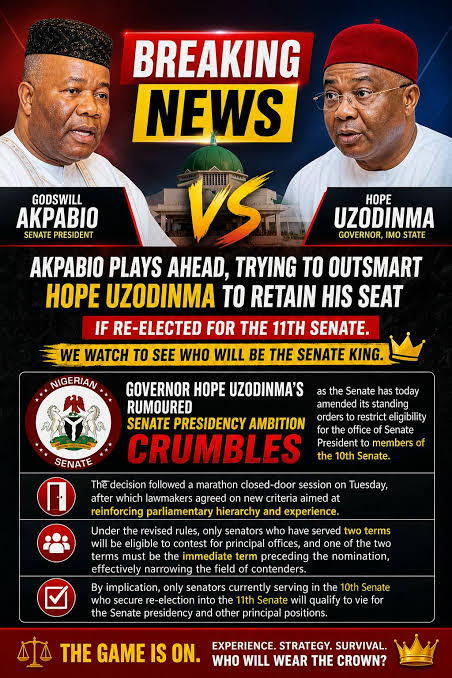
As political calculations ahead of the 2027 general elections gather momentum, attention is gradually shifting to the future leadership of the Nigerian Senate, with questions emerging over who could emerge as Senate President of the 11th National Assembly.
Among the political figures attracting attention in discussions about the succession are the incumbent Senate President, Godswill Akpabio, and Imo State Governor, Hope Uzodimma. Their names have featured in political conversations surrounding the ruling All Progressives Congress (APC), its internal power dynamics and the contest for influential positions in the next National Assembly.
However, the question of who will eventually wield the gavel remains open, as the outcome will depend on several factors, including the results of the 2027 elections, the composition of the incoming Senate, party decisions and the willingness of elected senators to support a particular candidate.
Although Akpabio currently occupies the position, Uzodimma’s influence within the APC has made him a figure of interest in broader discussions about the party’s future leadership arrangements. Nevertheless, any suggestion that either man has secured the position would be premature without a formal nomination and the necessary support among senators-elect.
Akpabio’s Incumbency and the Battle for Continuity
Akpabio assumed office as Senate President in June 2023, following the inauguration of the 10th National Assembly. His emergence came after a contest shaped by the APC’s zoning arrangements, negotiations among lawmakers and efforts to secure the backing of the party’s leadership.
As the head of the Senate, Akpabio presides over plenary sessions, oversees legislative proceedings and plays a central role in managing the chamber’s business. The office also carries considerable political influence because of the Senate’s responsibilities in lawmaking, national budgeting, oversight of the executive and confirmation of certain presidential appointments.
His supporters could argue that continuity in the Senate leadership would help sustain legislative coordination and preserve relationships developed during the current Assembly.
However, holding the position in one Assembly does not automatically guarantee another term. The Senate President is elected by senators at the beginning of each National Assembly, meaning that Akpabio would need to return to the Senate through the 2027 elections and secure the support required to retain the office.
The political environment could also change significantly after the elections, depending on the number of seats won by the APC and other parties, the emergence of competing candidates and the negotiations that follow the declaration of results.
For Akpabio, therefore, the road to another term would involve more than relying on his current position. He would need to maintain political alliances, secure the confidence of incoming lawmakers and navigate the party’s decisions on the distribution of leadership positions.
Uzodimma’s Political Influence and Possible Role
Uzodimma, a prominent APC governor and political figure from the South-East, occupies a different position in the debate.
As governor of Imo State, he has participated in party affairs and political negotiations involving the ruling party. His influence within the APC has made him relevant to discussions about the party’s strategy ahead of the 2027 elections and the distribution of political offices among its major interests.
His name appearing in conversations about the Senate presidency, however, raises an important distinction between political influence and eligibility for the office.
Under the constitutional framework governing the National Assembly, the Senate President is elected from among members of the Senate. Uzodimma would therefore have to become a senator before he could occupy the position.
Unless he secures election to the Senate in 2027, he cannot directly contest the office. His possible involvement in the debate could instead relate to his influence over party negotiations, support for a preferred candidate or participation in decisions concerning the APC’s legislative leadership.
Consequently, any discussion of Uzodimma as a potential Senate President must be considered in the context of the constitutional requirements and the political steps necessary for such an ambition to become realistic.
The APC’s Zoning Formula Could Be Decisive
One of the most important factors likely to shape the leadership of the 11th Senate is the APC’s approach to zoning and the distribution of political offices.
Nigeria’s major political parties often rely on zoning arrangements and regional balancing when allocating prominent positions. These arrangements are intended to accommodate competing interests, maintain party unity and ensure that different geopolitical zones have a stake in national leadership.
The APC’s decisions on the presidency, the leadership of the National Assembly and other key positions could therefore influence the contest for Senate President.
If the party decides to retain its existing regional arrangement, the geographical and political considerations surrounding Akpabio’s position could become significant. Conversely, a revised zoning formula could create opportunities for other aspirants, depending on the party’s calculations.
However, zoning does not automatically determine the final outcome. Even when a party endorses a preferred candidate, the Senate President must still be elected by members of the chamber.
This means that negotiations among senators-elect will remain crucial, particularly if several candidates emerge with competing claims to the position.
The Role of the 2027 Elections
The composition of the 11th National Assembly will be determined by the 2027 general elections, making the electoral outcome central to any discussion about its leadership.
The APC’s performance will be particularly important because the ruling party’s numerical strength could influence its ability to coordinate the emergence of a preferred candidate.
If the party secures a strong majority in the Senate, its internal negotiations could play a significant role in determining who receives its endorsement. If the chamber has a more competitive composition, candidates may need to negotiate across party lines to secure the required votes.
Individual senators-elect will also have their own political interests, regional considerations and preferences concerning the direction of the next Senate.
These factors mean that the contest may not be determined solely by the wishes of the party’s national leadership or the influence of prominent political figures.
Ultimately, the candidate who can build the broadest coalition among senators-elect will have a significant advantage when the chamber votes to elect its presiding officers.
Why the Senate Presidency Matters
The contest for the Senate presidency goes beyond the personalities involved because the office occupies a central position in Nigeria’s legislative and political system.
The Senate participates in the passage of national legislation, consideration of the federal budget, oversight of government ministries and agencies, and confirmation of appointments where constitutionally required.
The Senate President also influences the organisation of legislative business and helps manage debates on policies affecting the economy, security, education, healthcare and other national priorities.
The office carries additional political significance because it places its holder among the country’s most influential public officials.
For the ruling party, securing a Senate President who can maintain legislative cohesion may help facilitate its policy agenda. For the opposition, the leadership contest offers an opportunity to challenge the ruling party’s political arrangements and negotiate a stronger position within the chamber.
These competing interests help explain why discussions about the next Senate leadership often begin well before the inauguration of a new National Assembly.
Could the Contest Produce Surprises?
Nigeria’s political history demonstrates that leadership contests in the National Assembly can produce unexpected outcomes, particularly when party preferences conflict with the calculations of lawmakers.
Candidates may enjoy strong backing from party leaders but still face resistance from senators who favour a different arrangement. Others may emerge as compromise candidates after negotiations among competing political interests.
The 11th Senate could witness similar dynamics, depending on the outcome of the 2027 elections and the strength of the alliances formed before the inauguration.
For Akpabio, the challenge would be to defend his record and persuade incoming lawmakers that retaining him would serve their collective interests.
For Uzodimma, the question is whether his name represents a realistic personal ambition, a possible role in shaping the APC’s decision-making or simply part of wider political speculation. His eligibility to contest the position would depend on first becoming a member of the Senate.
Other political figures could also enter the race, meaning that the contest should not necessarily be viewed as a two-man affair.
Until the elections are concluded and the relevant political arrangements become clearer, the field remains open to developments that could change the calculations.
Conclusion: Akpabio or Uzodimma?
The question of who will wield the gavel in the 11th Senate remains unresolved, with Akpabio’s incumbency and Uzodimma’s political influence representing different dimensions of the debate.
Akpabio has the advantage of occupying the office and possessing direct experience in the Senate, but he would need to return to the chamber and secure the support of its incoming members to retain the position.
Uzodimma, meanwhile, remains an influential APC figure whose potential involvement in the succession debate must be assessed against the constitutional requirement that the Senate President be elected from among serving senators.
Beyond both men, the APC’s zoning decisions, the results of the 2027 elections and the alliances formed among senators-elect will shape the eventual outcome.
For now, the race for the 11th Senate presidency remains a question of political calculations rather than a settled contest. The decisive moment will come when the new Senate is inaugurated and its members elect the person who will preside over the chamber.