
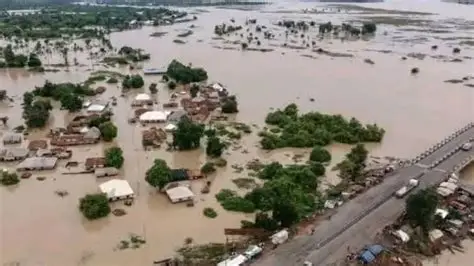


As the rain begins, the Federal Government, on Wednesday, released the 2026 Annual Flood Outlook (AFO), predicting floods to hit Bayelsa, Delta, Adamawa, Kebbi and 29 other states.
This was disclosed in a keynote address by the Minister of Water Resources and Sanitation, Engr Joseph Utsev, at the AFO public presentation at the Presidential Banquet Hall, Abuja, organised by the Nigeria Hydrological Services Agency, NiHSA, with the theme ‘Smart Water Resources Management: Moving from Oil to Water-Based Economy’.
Utsev acknowledged that early information saves lives, livelihoods, protects infrastructure, and reduces economic losses, saying that, as part of the Federal Government’s commitment to improving flood forecasts and preparedness, is the modernisation of the national hydrological monitoring networks.
The minister also said his ministry is strengthening collaboration with the Nigerian Meteorological Agency, NiMet, to ensure better integration of weather and water information, as it is critical for delivering reliable forecasts that support farmers, disaster managers, urban planners, and other key sectors of the economy.
He said AFO is therefore not just a scientific report, it is a call to action by all in terms of preparation ahead of the flood season, as early information saves lives, livelihoods, protects infrastructure, and reduces economic losses.
However, the minister acknowledged that forecasts alone are not sufficient if the information does not translate into action at the community level, which he said his Ministry is working with other relevant government agencies to mitigate the impacts of flooding.
Meanwhile, the 2026 AFO presentation had in attendance President Bola Tinubu, represented by the Minister of Environment, Balarabe Lawal.
Others present were the federal ministries: Water Resources and Sanitation; Livestock Development, Environment and Women Affairs.
Others include the Speaker of the House of Representatives, State Governments, Service Chiefs, development partners and the media.
He said: “The 2026 flood forecast presented today provides us with the following general highlights: High Flood Risk: 14,118 communities in 266 Local Government Areas (LGAs) in 33 States and FCT fall within the high flood risk areas. The States are: Abia, Adamawa, Anambra, Bauchi, Bayelsa, Benue, Borno, Cross River, Delta, Ebonyi, Edo, Enugu, Gombe, Imo, Jigawa, Kaduna, Kano, Kebbi, Kogi, Kwara, Lagos, Nasarawa, Niger, Ogun, Ondo, Osun, Oyo, Plateau, Rivers, Sokoto, Taraba, Yobe, Zamfara and the FCT.
“Moderate Flood Risk: 15,597 Communities in 405 LGAs, 35 states except Ekiti State, will experience moderate flood risk.
“Low Flood Risk: Incidences of minimal flood is expected in 923 communities in 77 LGAs in 24 States. The States are Adamawa, Anambra, Bauchi, Bayelsa, Benue, Borno, Cross River, Delta, Ebonyi, Edo, Jigawa, Kaduna, Kano, Kebbi, Kogi, Nasarawa, Niger, Ogun, Ondo, Osun, Oyo, Sokoto, Taraba and Zamfara.
“Flash and Urban Flooding: Flash and urban flooding are projected in major cities in the country due to high rainfall intensities, low attention to management of water facilities including drainage systems, waterways and lack of flood resilience structures. Cities such as Abakaliki, Abeokuta, Abuja, Asaba, Benin City, Birnin–Kebbi, Calabar, Ibadan, Kaduna, Kano, Lagos, Makurdi, Nguru, Onitsha, Oshogbo, Port Harcourt, Sokoto, Warri and Yola, among others are to experience these categories of flood incidence.
“Coastal and Riverine Flooding: Bayelsa, Cross River, Delta, Lagos, Ogun, Rivers and Ondo are to experience coastal flooding due to rise in sea level and tidal surge and this would impact on fishing, wildlife habitation and river navigation.”
He also emphasised that, “As we transition toward a water-based economy, we must recognize that water security is national security. Effective water governance will play a critical role in ensuring food security, supporting economic diversification, and improving the overall well-being of our citizens.”
However, the Minister called on State and Local Governments including communities to start preparation to mitigate the impacts of the predicted flood.
“I therefore call on state governments, local authorities, disaster management agencies, farmers, and community leaders to carefully study the findings and advisories contained in this document and take the necessary steps to prepare for the coming flood season.
“Furthermore, we are encouraging state governments to integrate flood risk considerations into land-use planning, urban development, and infrastructure design.
“Floodplains must be properly managed, drainage systems must be improved, and communities must be empowered to adapt to changing climate conditions.
“Preparedness remains the most effective strategy for reducing flood risks. When we plan ahead, we protect lives, safeguard infrastructure, and preserve economic gains. Let us commit to building a safer, more resilient and more water-secure nation.”
Earlier, the Director General/Chief Executive Officer, Nigeria Hydrological Services Agency, Umar Ibrahim Mohammed, NiHSA, said the 2026 AFO aligns with the Renewed Hope Agenda in terms of economic diversification, infrastructure development, climate resilience, food security and sustainable water management.
Mohammed also explained that, “The AFO has evolved into an important national planning instrument that provides early scientific prediction of flood risks in the country, evidence-based guide for decision-makers and platform for emergency coordination among stakeholders.
“In producing this year’s forecast, the Agency undertook a comprehensive and data-driven process to provide tailored information for high-risk flood zones and flash floods in urban cities and towns.
“Building on the success achieved through AFO publications, we have upgraded from reporting flood forecast to Flood Risk Intelligence Architecture and from the traditional modelling to Hybrid AI-Integrated Modelling system to improve forecast reliability, reduce false alarms and improve the lead time accuracy.
“Not these alone, the modelling for the 2026 forecast have been conducted in-house. This marks a strategic shift toward enhancing capacity building, manpower development and institutional resilience.”
Meanwhile, according to the NISHA boss, the Agency’s Flood Dashboard has been upgraded to full-scale Decision-Support Geo-Intelligence System that enable real-time visualisation and impact-based flood scenarios.
He further stated that, “The Dashboard is integrated with a dedicated Flood Mobile App to enhance accessibility and dissemination of flood information and alerts. We have the team of NiHSA’s flood marshals at back-end who are on hand to provide assistance and respond to queries.”
The Director General/Chief Executive Officer, Nigeria Meteorological Agency, NiMET, Prof Charles Anosike, in a goodwill message, acknowledged the devastating effects of flooding that Nigerian and other African countries still struggle to contain.
Anosike also said that with technology, there have been predictions to mitigate the impacts, and said NiHSA has done well with the presentation of AFO to protect the nation.
He also said NiMET and NiHSA are sister organisations working together to help the country in the management of floods, and added that Nigeria should rethink its development strategy by prioritising issues concerning water resources. He assured that NiMET will continue to work with NiHSA to strengthen predictions.