

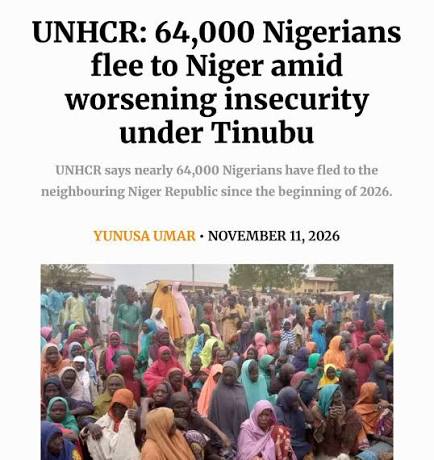
Nearly 64,000 Nigerians have fled their homes and crossed into neighbouring Niger Republic since the beginning of 2026 to escape escalating insecurity involving Islamist militants and armed criminal groups, the United Nations High Commissioner for Refugees (UNHCR) has disclosed.
The UN refugee agency raised the alarm in a briefing issued on Tuesday, November 10, 2026, warning that the increasing movement of displaced Nigerians was worsening an already critical humanitarian situation in Niger.
According to UNHCR, the country currently hosts more than 500,000 refugees and asylum-seekers, including approximately 327,500 Nigerians who had previously fled violence and insecurity in their homeland.
The agency also disclosed that several hundred Nigerians had sought refuge in neighbouring Benin Republic as attacks and other security challenges continued to affect communities across northern Nigeria.
UNHCR’s Director of External Relations, Dominique Hyde, said most of the newly arrived Nigerian refugees had settled in the border regions of Diffa, in southeastern Niger, and Tahoua, in the western part of the country.
Both regions share borders with Nigeria and are already facing significant challenges, including insecurity, climate-related difficulties and pressure on available public services.
The agency revealed that about 1,200 people crossed into Diffa in October alone, while another 3,400 arrived in Tahoua during the same period.
In Diffa, more than 23,000 people, over two-thirds of them children, have arrived since the beginning of the year, highlighting the growing scale of displacement caused by insecurity.
Refugees Face Difficult Living Conditions
UNHCR expressed serious concern over the living conditions of thousands of newly displaced Nigerians, many of whom are struggling to access basic necessities.
The agency said several families were living in makeshift shelters that offered little protection against harsh weather conditions, while access to food, clean drinking water, healthcare and other essential services remained extremely limited.
Some refugee women reportedly have to walk several kilometres every day to collect water for their families, exposing them to additional difficulties and protection risks.
Humanitarian organisations operating in the affected communities have also reported increasing cases of malnutrition, respiratory infections and poor sanitation among newly arrived refugees.
The situation is particularly worrying for children, who make up a significant proportion of the displaced population and are among those most vulnerable to hunger, disease and inadequate shelter.
Education has also emerged as a major concern, as some locations lack schools and transitional learning facilities for children arriving from Nigeria.
UNHCR noted that differences in the educational systems and languages used in both countries could create additional difficulties for Nigerian children attempting to continue their education.
Only Five Per Cent of New Arrivals Registered
The refugee agency also raised concerns over the limited registration of Nigerians arriving in Niger.
According to UNHCR, only about five per cent of Nigerian refugees who entered the country this year have been formally registered, largely because of inadequate resources.
The lack of proper documentation makes it difficult for many displaced families to access humanitarian assistance, healthcare and other essential public services.
Without registration, refugees may also face increased protection risks and difficulties establishing their identities and accessing available support.
The agency warned that addressing the documentation challenge was critical to ensuring that vulnerable families were properly identified and provided with the assistance they needed.
Insecurity and Climate Challenges Worsen Humanitarian Crisis
Beyond the influx of refugees, UNHCR said Niger was also struggling with its own security and environmental challenges, particularly in the Diffa region.
The agency disclosed that more than 70 per cent of Niger’s reported security incidents this year, including armed attacks and violence against civilians, had occurred in Diffa.
The situation has been further complicated by drought and irregular rainfall during the 2026 rainy season, which have negatively affected agricultural production and pastureland.
According to the agency, grain production is expected to be insufficient in about 700 of the 1,000 villages in the region, while an estimated 70 per cent of pastureland has been lost.
These challenges are placing additional pressure on host communities, whose resources and livelihoods are already under considerable strain.
Consequently, the arrival of thousands of Nigerian refugees is increasing demand for food, water, shelter and other basic services in communities already facing significant humanitarian difficulties.
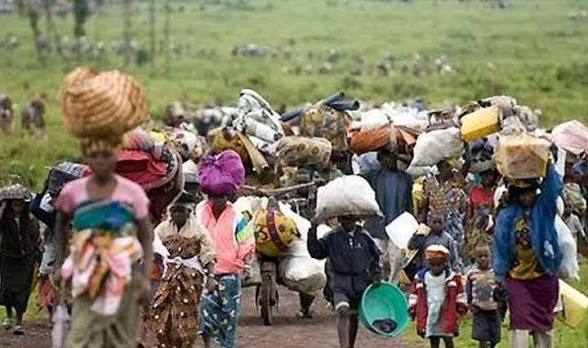
UNHCR Commends Niger’s Support, Seeks International Assistance
Despite the growing challenges, UNHCR acknowledged the support provided by Nigerien authorities and host communities in accommodating displaced Nigerians.
The agency commended local communities for demonstrating solidarity, including making land available for temporary shelters to accommodate families fleeing violence.
However, it warned that the capacity of the authorities and host communities to support the increasing number of refugees was becoming overstretched.
UNHCR is therefore calling on the international community, humanitarian organisations and development partners to urgently increase assistance to affected populations.
The agency is seeking $11.4 million to strengthen its humanitarian response across Niger, Nigeria and Benin.
Of the amount, $2 million is being requested for immediate interventions covering food distribution, clean water, temporary shelter, healthcare, refugee registration and protection services.
The agency said additional funding would also support longer-term solutions, including livelihood opportunities and measures aimed at helping displaced families rebuild their lives.
UNHCR warned that without additional financial support, thousands of vulnerable families could be left without access to essential humanitarian assistance as displacement continues.
Growing Concern Over Nigeria’s Security Situation
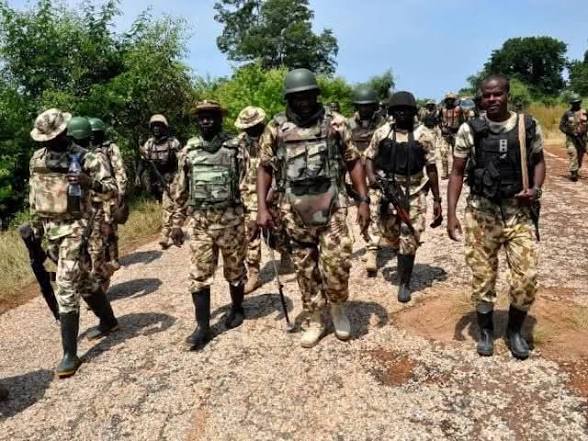
The latest figures have renewed concerns over the humanitarian consequences of persistent insecurity in northern Nigeria, where attacks by Islamist militant groups, armed bandits and other criminal networks have continued to threaten lives and livelihoods.
For many affected families, fleeing across the border has become a desperate attempt to escape violence and find a safer environment for their children and loved ones.
However, the increasing number of Nigerians seeking refuge in neighbouring countries demonstrates that the consequences of insecurity are extending beyond Nigeria’s borders.
The situation also highlights the need for stronger security measures, effective humanitarian interventions and coordinated regional efforts to address the factors forcing people from their communities.
As thousands of families continue to struggle with displacement, UNHCR has urged the international community to provide urgent assistance to prevent the humanitarian situation from deteriorating further.