

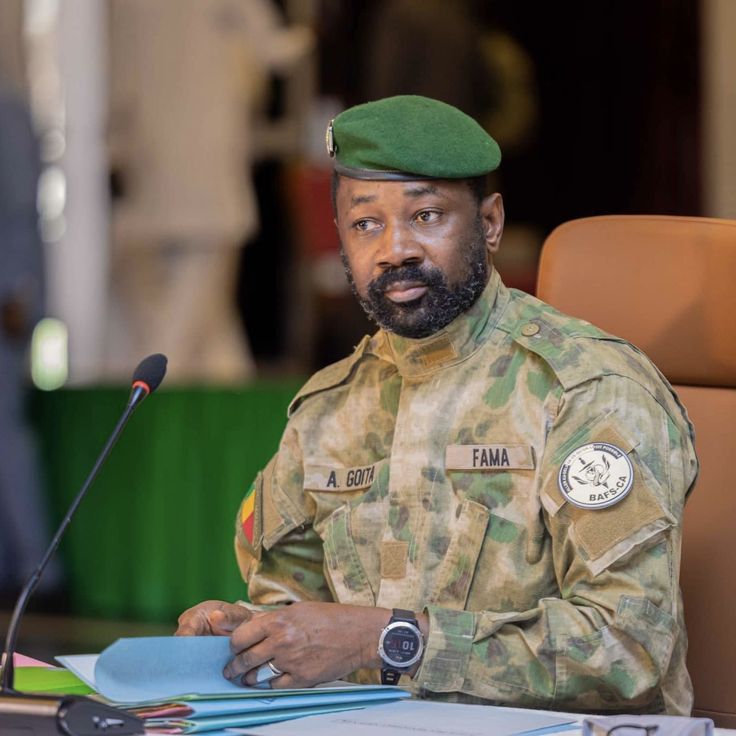
Mali’s military ruler, Gen. Assimi Goïta, has assumed direct control of the defence ministry following the killing of Defence Minister Sadio Camara in a coordinated rebel attack that has deepened the country’s security crisis.
The takeover comes more than a week after an alliance of separatist fighters and jihadist militants launched a series of nationwide raids across Mali, including near the capital, Bamako. According to a decree announced on state television on Monday, Goïta will now serve as both president and defence minister. He will be supported by army chief of staff Gen. Oumar Diarra, who has been named minister delegate for defence.
The move is widely seen as an effort by Goïta to tighten his grip on power at a moment when his government’s authority is under renewed pressure.
Camara was killed in what authorities described as a suicide truck bombing targeting his residence on the outskirts of Bamako. The strike was part of a broader offensive launched on April 25 by two groups: the separatist Azawad Liberation Front (FLA) and JNIM, an al-Qaeda affiliate in the Sahel.
The insurgents used coordinated gunfire and explosives to hit multiple towns and cities at dawn, catching Malian forces off guard. In the aftermath, the alliance has established a partial blockade around Bamako and other urban centers, restricting movement and supplies.
The scale of the assault forced Malian troops and their Russian paramilitary allies to withdraw from the northern city of Kidal, a symbolic loss that has raised fresh questions about the junta’s ability to secure the country.
In response, Malian authorities said they had arrested several soldiers, both current and former, suspected of colluding with the attackers. The public prosecutor at Bamako’s military court stated that an investigation had uncovered complicity in planning and carrying out the raids.
Mali has also coordinated air strikes with the armed forces of neighboring Niger and Burkina Faso, targeting rebel positions. Niger’s government confirmed that the joint operation began within hours of the initial attacks.
The three countries, all currently under military rule, have formed the Alliance of Sahel States. Since seizing power, they have expelled French troops and turned to Russian military support to counter the insurgency spreading across the Sahel region. Despite this shift, large swaths of territory in Mali, Niger, and Burkina Faso remain outside state control.
Goïta first came to power in an August 2020 coup and has since overseen two further power grabs, positioning himself as Mali’s transitional president. By now taking on the defence portfolio directly, he is consolidating authority over both political and military decision-making at a time when the junta faces its most serious battlefield challenge in years.
Analysts say the consolidation reflects both necessity and risk. While it centralizes command during a crisis, it also exposes Goïta to greater accountability if security continues to deteriorate. The offensive has already undermined public confidence in the junta’s promise to restore stability after the withdrawal of French forces.
The attack underscores how fragile the security situation remains across the Sahel, where jihadist and separatist groups have expanded despite foreign military interventions. Russian paramilitary units have been conducting air strikes to support Malian forces, but footage of recent advances by rebels suggests the insurgency retains significant operational capacity.
For residents in Bamako, the blockade has raised immediate concerns about supply routes and safety. “How are we going to get back home?” one resident asked, as checkpoints and road closures disrupted travel around the capital.
With no clear end to the offensive in sight, Goïta’s government faces mounting pressure to demonstrate that its military strategy and foreign alliances can reverse the insurgents’ gains.