

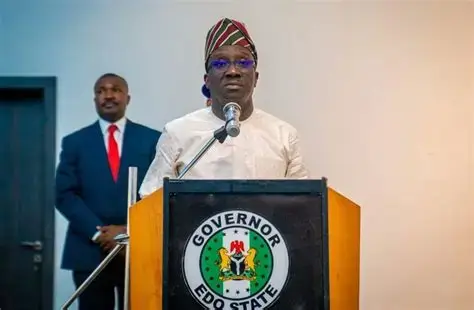
When Edo State Governor, Senator Monday Okpebholo, declared that the returned Benin Bronzes belong to the Oba of Benin’s Palace and should never be politicised, he did more than receive an international delegation at Government House, Benin City. His remarks spoke to history, justice, identity, and the enduring quest to restore one of Africa’s greatest cultural treasures to its rightful home.
Hosting officials of the National Commission for Museums and Monuments (NCMM), representatives of the Swiss Government, and museum experts from the University of Zurich, Governor Okpebholo described the return of the artefacts as “a defining history in our land.”
“First of all, let me thank you for this moment because this is a defining history in our land,” he said. “To me, there is no point in playing politics with what belongs to the palace.”
Those words captured the essence of a debate that has persisted for years. The Benin Bronzes are not merely priceless works of art; they are enduring symbols of the history, culture, spirituality, and identity of the Benin Kingdom.
The governor further explained why the artefacts hold such profound significance for the people of Edo State.
“We have culture here. I believe in our culture. Those bronzes are not just bronze; they are symbolic and spiritual to our kingdom. Wherever they are, they will all find their way back to Nigeria, to Edo State,” he stated.
His remarks followed Nigeria’s receipt of 18 Benin Bronzes and five other priceless cultural objects returned by Switzerland. These treasures are among the thousands of artefacts looted during the British invasion of the Benin Kingdom in 1897, when the royal palace was attacked and its priceless collections carted away to Europe.
For more than 125 years, many of these objects remained scattered across museums and private collections around the world. Their gradual return represents more than the repatriation of cultural property; it is an acknowledgment that they were acquired through colonial violence and belong to the people from whom they were taken.
Although the latest restitution represents only a small fraction of the thousands of Benin artefacts still outside Nigeria, every successful return advances the global campaign for historical justice and cultural restitution.
Governor Okpebholo was unequivocal on the issue of ownership.
“There is no point playing politics with them. They all belong to the Oba’s Palace. We have only one Oba’s Palace in Edo State,” he declared.
His position is significant because debates over the custody of returned Benin artefacts have, at times, generated unnecessary disagreements between government institutions and traditional authorities. By affirming the Oba’s Palace as the rightful custodian, the governor reinforced the central role of the traditional institution in preserving the heritage of the Benin Kingdom while positioning government as a committed partner in that responsibility.
The governor also reflected on the historical circumstances that led to the removal of the artefacts.
“The British that came here came for a reason. They heard something about the Benin Empire. That is why they came here. They found these things very interesting and took them out of this country to theirs,” he said.
His observation underscores an undeniable historical reality. Long before colonial conquest, the Benin Kingdom had earned global recognition for its sophisticated governance, flourishing commerce, remarkable bronze casting tradition, and exceptional artistic excellence. The famous plaques, commemorative heads, and ceremonial objects remain among the finest examples of African artistry ever produced.
Governor Okpebholo therefore welcomed Switzerland’s decision to return the artefacts.
“I am happy that the Swiss Government has decided to say, ‘Yes, let’s return these back to the owners.’ I want to thank your government for taking this initiative in bringing these bronzes back to our palace,” he said.
He added that while the gesture might appear modest, its significance would endure for generations.
“It might look small to you, but the blessings ahead are huge.”
The visit also highlighted the growing international cooperation driving the restitution movement.
Director-General of the NCMM, Olugbile Holloway, described Benin as “ground zero” in the global campaign for the return of looted African cultural heritage.
“The National Commission for Museums and Monuments is at the forefront of the battle for restitution,” Holloway said.
He disclosed that the commission is working closely with the Oba of Benin to facilitate the return of many more artefacts currently held in foreign museums.
“We are working with the palace and His Royal Majesty to ensure that as many of these bronzes that found their way into foreign museums begin to come home,” he stated.
Holloway also confirmed that all the artefacts returned by Switzerland had arrived safely in Nigeria and would be presented symbolically to the Oba of Benin for traditional blessings before being formally reintegrated into the kingdom’s cultural heritage.
That ceremony reinforces what generations of Edo people have always maintained: the Benin Bronzes are living cultural and spiritual symbols, not merely museum exhibits.
Speaking on behalf of Switzerland, Consul General Conny Camenzind described the restitution as an important milestone in relations between Switzerland and Nigeria.
She said Switzerland was proud to have worked alongside the NCMM and participating museums to facilitate the return of the artefacts and expressed optimism that the exercise would mark the beginning of an even stronger partnership between both countries.
Her remarks reflect a growing international recognition that governments and museums have both a moral and historical responsibility to confront the legacy of colonial-era looting.
Across Europe and North America, attitudes toward the Benin Bronzes continue to evolve. The Netherlands has agreed to return more than 100 Benin artefacts, while museums in Germany, the United States, and the University of Cambridge have also returned important collections or transferred ownership to Nigeria. Switzerland’s latest restitution adds further momentum to this global movement.
The British Museum, however, continues to hold one of the world’s largest collections of Benin objects, maintaining that existing legislation prevents their permanent return. For many Nigerians, this remains one of the most significant unresolved issues in the broader quest for historical justice.
Each successful restitution therefore carries significance far beyond the number of objects involved. Every returned artefact strengthens Nigeria’s case, encourages other museums to examine the provenance of their collections, and demonstrates that historical wrongs can be addressed through dialogue, cooperation, and goodwill.
The campaign also forms part of a broader African movement advocating the return of cultural treasures removed during colonial rule. Among all such artefacts, the Benin Bronzes have become perhaps the most powerful symbol of that struggle because they embody artistic excellence, cultural identity, national pride, and historical justice.
Governor Okpebholo’s intervention deserves particular recognition because it shifted attention away from political contestation and towards the larger issues of heritage, identity, and respect for traditional authority. His message was both timely and unifying.
The Benin Bronzes tell the story of kings, craftsmen, warriors, and generations of Edo people whose civilisation flourished centuries before colonialism. Their return restores not only priceless works of art but also an essential part of the history, dignity, and identity of the Benin Kingdom.
As more museums around the world continue to reassess the origins of their collections, Governor Okpebholo’s message is likely to resonate even more strongly: the Benin Bronzes are far more than historical artefacts. They are enduring symbols of a proud civilisation, and their rightful home remains the Oba of Benin’s Palace.
— Dr. Ebojele holds a PhD in Public Administration and serves as Chief Press Secretary to Governor Monday Okpebholo of Edo State.