

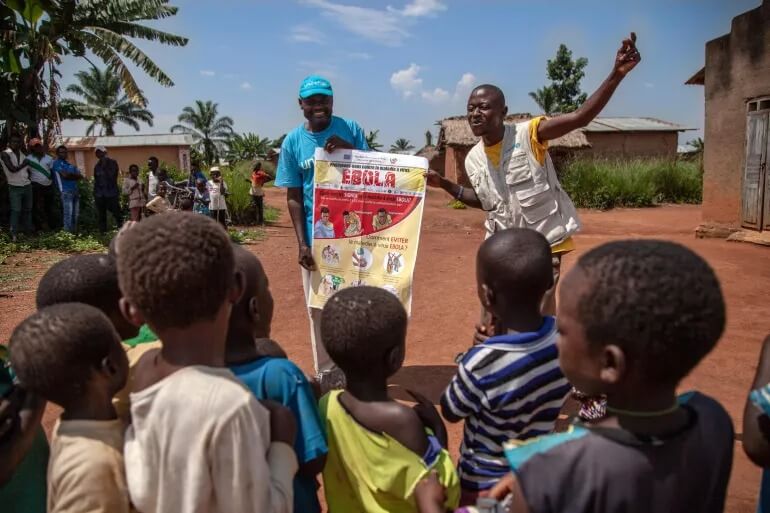
Children in the Democratic Republic of the Congo (DRC) have returned to school as the country continues to battle its largest Ebola outbreak on record, raising concerns among parents and teachers, particularly in the hardest-hit province of Ituri.
According to government figures, the country had recorded 6,041 confirmed Ebola cases and 2,911 deaths by August 31. The outbreak has spread across six of the DRC’s 26 provinces, with Ituri remaining the centre of the crisis. As of August 26, the province had registered 4,802 confirmed cases.
Parents Worried About School Reopening
In Bunia, the capital of Ituri, some parents are questioning the decision to resume classroom teaching while Ebola continues to spread.
Dieudonne Lotsima, a father of three, said parents want the government to explain what measures are being introduced to protect pupils.
He believes schools should have remained closed until a vaccine specifically effective against the virus responsible for the current outbreak becomes available. He also worries that young children may not consistently follow hygiene measures such as handwashing, potentially exposing their families to infection.
The outbreak is being caused by the Bundibugyo virus, a strain of ebolavirus that differs from the Zaire ebolavirus responsible for most previous Ebola outbreaks in the DRC.
At present, there is no vaccine or treatment specifically approved for Bundibugyo virus disease. The Ervebo vaccine, which is approved for protection against Zaire ebolavirus, is being administered to frontline health workers, although its effectiveness against Bundibugyo has not yet been confirmed. The World Health Organization is supporting research to determine whether the vaccine can provide protection against the current strain.
Government Introduces Different Measures
Instead of closing schools nationwide, the government has adopted different approaches based on the level of Ebola risk in each area.
Communities considered to be at the highest risk will rely on home-based learning. According to the Ministry of Education, pupils in these areas will receive printed learning materials and worksheets based on essential parts of the curriculum. Radio programmes will also be used to support lessons, with radios potentially provided to families that do not have access to them.
Education Minister Raissa Malu said on August 18 that 40 of the 138 educational subdivisions located in Ebola-affected provinces had been impacted by the outbreak. Eighteen of those subdivisions were considered high-risk areas.
The government has divided affected locations into three categories: green areas, where there is no known Ebola transmission; orange areas, where the outbreak is present but schools can operate with additional precautions; and red areas, where the risk is considered particularly high.
Officials have stressed that the home-learning programme will rely on printed materials and radio rather than internet-based education.
Despite these measures, some parents remain hesitant about sending their children back to school. Catherine Neema, a mother of two from Bunia, said she was worried that crowded classrooms could increase the chances of transmission.
She noted that when her older child began the school holiday, the country had reported roughly 1,500 Ebola cases and 470 deaths, numbers that have since risen sharply.
Teachers Demand Better Safety Measures
Teachers’ representatives in Ituri are also expressing concern about the reopening of schools.
The Ituri 1 Teachers’ Inter-Union Committee says the current health situation does not provide sufficient reassurance for a safe return to classrooms.
Trade union member Budju Lobo Isaac called for schools to meet basic health and safety requirements before pupils and teachers return. These measures, he said, should include adequate handwashing facilities, hand sanitiser, temperature screening equipment, as well as monitoring and support for teachers.
Education authorities have meanwhile begun training staff in Ituri on Ebola prevention. The training focuses on recognising risky behaviour, encouraging protective practices and educating pupils about the disease.
Officials say inspectors, senior education personnel and representatives of teachers’ unions have received training and will help pass the information on to school administrators and teachers across affected areas.
Schools Could Also Support Ebola Awareness
Despite the concerns surrounding reopening, health officials believe schools could play an important role in controlling the outbreak.
Professor Yap Boum, the Africa Centres for Disease Control and Prevention’s incident manager for the Bundibugyo response, said schools provide an opportunity to educate children about Ebola and encourage them to share that information with their families.
According to Boum, children who learn about Ebola prevention at school can take the knowledge home and help raise awareness among adults.
As the DRC attempts to balance education with public health, authorities face the challenge of keeping children in school while preventing classrooms from becoming another avenue for Ebola transmission.