

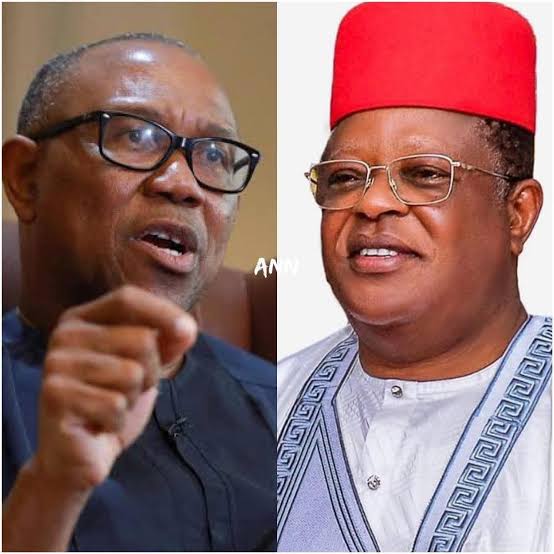
Minister of Works, David Umahi, has declared that former Labour Party presidential candidate Peter Obi cannot be regarded as the best political leader from the South-East, renewing the debate over political leadership, performance and representation in the region.
Umahi, a former governor of Ebonyi State, made the remark amid ongoing political discussions about the South-East’s role in Nigeria’s national leadership and the contributions of prominent political figures from the region.
Obi, who served as governor of Anambra State from 2006 to 2014, gained national prominence following his performance in the 2023 presidential election, where he emerged as the Labour Party’s candidate and secured substantial support from voters across several parts of the country.
His performance, particularly in the South-East, strengthened his standing among supporters who see him as a credible alternative to the established political parties. However, his political influence has also attracted criticism from opponents who question his leadership record, political strategy and claims of being the preferred candidate for the region.
Umahi, who previously served two terms as governor of Ebonyi State before joining the All Progressives Congress, is also a prominent political figure in the South-East. His experience in state governance and his current position as Minister of Works have placed him at the centre of discussions concerning infrastructure development and the region’s political representation.
The minister’s assessment of Obi highlights the differences in opinion among political leaders over who deserves recognition as the South-East’s most outstanding political figure.
The region has produced several influential politicians who have occupied important positions in government, including former governors, ministers, senators and other public office holders. Their supporters often assess their contributions based on infrastructure development, economic policies, public service, political influence and their ability to attract federal projects to their respective states.
Obi’s supporters frequently point to his record as Anambra governor, his emphasis on prudent management of public resources and his appeal among young Nigerians as evidence of his leadership qualities. They also argue that his performance in the 2023 presidential election demonstrated his ability to attract support beyond his traditional political base.
However, critics have questioned whether his achievements in Anambra and his electoral performance are sufficient to establish him as the region’s most outstanding leader. They argue that leadership assessments should consider a broader range of factors, including long-term development, political influence and measurable improvements in citizens’ living conditions.
Umahi’s comments are likely to generate further reactions among political stakeholders and supporters of the two leaders, particularly as political activities gradually intensify ahead of the 2027 general elections.
The contest for political relevance in the South-East remains significant as parties and influential politicians seek to strengthen their positions ahead of the next electoral cycle. The region’s leaders are also under pressure to address concerns relating to infrastructure, insecurity, economic development, employment and greater representation in national affairs.
Beyond the disagreement over individual political figures, the debate raises questions about the criteria that should determine who is regarded as the South-East’s best leader. While some voters prioritise governance records and infrastructure, others place greater emphasis on national influence, economic management, integrity and the ability to unite different political interests.
As political discussions continue, the views expressed by Umahi and the responses they may attract are expected to contribute to broader conversations about leadership, accountability and the future political direction of the South-East.