

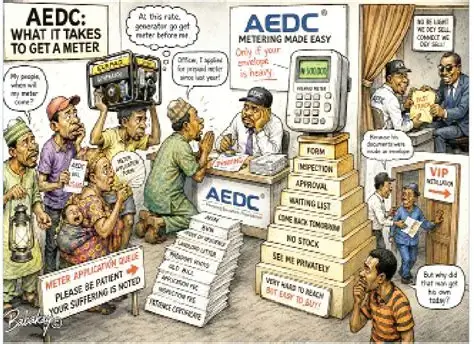
Data may provide useful insight into Nigeria’s electricity sector, but it does not always capture the realities faced by consumers. For one workplace in Abuja, the struggle to obtain a prepaid electricity meter after being disconnected from the national grid in February has dragged on for seven months.
Before the disconnection, the organisation operated under an estimated billing arrangement. However, the system became increasingly problematic following the introduction of higher tariffs for Band A customers.
According to the organisation, customers without prepaid meters became vulnerable to arbitrary billing, with bills reportedly rising to more than twice previous charges. Staff of the Abuja Electricity Distribution Company (AEDC) allegedly demanded payment of the estimated bills or hinted that customers could “do something” to resolve the issue.
Frustrated by the situation, the organisation eventually opted to manage its electricity needs using generators and partial solar power. An internal audit reportedly showed that, despite energy costs rising by between 500 and 600 per cent over the past three years, relying on alternative power sources would not be significantly more expensive than AEDC’s estimated bills.
However, the organisation continued pursuing a prepaid meter and formally lodged complaints with AEDC.
Attempts to secure a meter
The organisation said it contacted AEDC’s Managing Director, Chijoke Okwuokenye, who referred the matter to an engineer, Jonathan Adeyemi. After applying for a meter, the organisation was reportedly informed that AEDC did not have prepaid meters available and was directed to an approved vendor.
The organisation later sought assistance from AEDC’s Chief Operating Officer, Engineer Blessing Ogbe, whom it met at an event organised by the Nigeria Union of Journalists in Abuja.
Ogbe reportedly requested copies of previous correspondence and introduced the organisation to AEDC’s corporate affairs department. Despite further follow-ups, however, the meter issue remained unresolved.
In June, the organisation contacted one of the approved private meter providers based in Lagos. The company conducted a survey at the workplace and subsequently submitted its findings to AEDC.
However, a field engineer from the private company later informed the organisation that it had completed its part of the process but was waiting for a response from AEDC.
Broader electricity sector challenges
The prolonged experience has highlighted wider problems within Nigeria’s electricity distribution sector, including inadequate metering, technical losses, ageing infrastructure, electricity theft and poor revenue collection.
Although AEDC is considered one of the better-performing distribution companies, the organisation’s experience underscores the difficulties consumers can face even when attempting to comply with the metering requirements of the electricity market.
The Federal Government has invested heavily in the power sector over the years, while the Nigerian Electricity Regulatory Commission (NERC) has introduced measures aimed at curbing estimated billing and improving customer protection.
NERC had previously sanctioned AEDC over non-compliance with regulations on capping estimated bills, highlighting persistent concerns over billing practices within the sector.
Meter still awaited
After months of correspondence and follow-ups, AEDC reportedly informed the organisation in July that it required a meter compatible with a 500KVA transformer, rather than the 300KVA meter initially assessed.
The organisation was subsequently directed to an Abuja-based private Meter Asset Provider to supply the required equipment at a cost of N2.89 million.
Seven months after the process began, the workplace remains off the national grid and is still waiting for its prepaid meter.
For the organisation, the experience reflects a much broader problem in Nigeria’s electricity sector: despite investments, regulations and repeated promises of improved metering, consumers continue to struggle with unreliable power supply, estimated billing and difficult customer-service processes.