

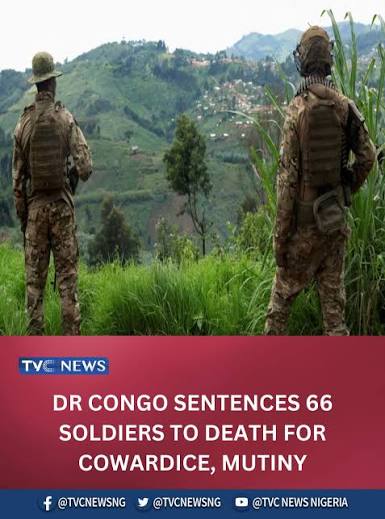
A military court in the Democratic Republic of Congo (DR Congo) has sentenced 66 soldiers to death over allegations of cowardice, mutiny, disobedience and abandoning their positions during clashes with rebel fighters in the country’s eastern region.
The verdict followed a trial involving 71 members of the Congolese Armed Forces (FARDC), who were accused of failing to carry out their military responsibilities during operations against armed groups in the conflict-hit North Kivu Province.
According to reports, the soldiers were arrested on October 20 following separate incidents in which they allegedly abandoned their positions and fled from confrontations with fighters belonging to the Front for the Refoundation of the Nation (FRN), a rebel coalition that includes the M23 movement.
The trial lasted 12 days and was conducted before a military court sitting in Walikale, North Kivu Province.
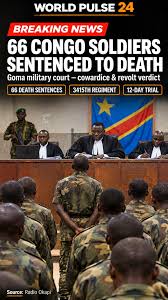
The court found 66 of the defendants guilty and handed down death sentences, while four soldiers were acquitted. Another defendant, an intelligence officer, was sentenced to 10 years in prison.
Prosecutors had reportedly requested the death penalty for 70 of the defendants, while seeking a 10-year prison sentence for the intelligence officer.
Army Defends Decision to Punish Soldiers
Congolese military authorities have defended the prosecution, describing it as part of efforts to restore discipline and strengthen operational effectiveness within the country’s armed forces.
Major Dieudonne Kasereka, the army’s head of communications in the affected region, said the charges were necessary to reinforce discipline among troops operating in North Kivu and South Kivu, where government forces have continued to face attacks from armed groups.
The military has been battling several rebel movements in eastern DR Congo, a region that has experienced years of insecurity, territorial disputes and repeated clashes between government forces and insurgents.
Authorities believe that soldiers abandoning their positions during active military operations could undermine military strategies and expose other troops and civilian communities to greater danger.
Ongoing Conflict in Eastern DR Congo
Eastern DR Congo has remained one of the country’s most troubled regions, with government troops engaged in prolonged fighting against several armed groups, particularly the M23 movement.
The M23 is part of the Front for the Refoundation of the Nation (FRN), an umbrella rebel coalition involved in the conflict.
The fighting has resulted in widespread displacement, destruction of communities and a worsening humanitarian situation, with thousands of civilians affected by the violence.
The Congolese government has repeatedly accused neighbouring Rwanda of supporting the M23 rebels, an allegation Kigali has denied.
The continued fighting has placed enormous pressure on the Congolese military, which has faced challenges involving organisation, inadequate equipment, logistics and complaints about poor conditions of service among some soldiers.
Another 27 Soldiers Previously Sentenced to Death
The latest verdict comes weeks after another 27 Congolese soldiers were sentenced to death over allegations of cowardice after reportedly withdrawing from frontline positions during clashes with rebel fighters.
The repeated death sentences highlight the government’s increasingly tough approach towards military personnel accused of abandoning their duties during operations against insurgents.
According to figures compiled by French broadcaster Radio France Internationale (RFI), at least 381 Congolese soldiers have received death sentences since the beginning of 2025.
The growing number of convictions has drawn attention to the country’s military justice system and the treatment of soldiers accused of misconduct during armed conflicts.
DR Congo Reintroduced Death Penalty in 2024
The Democratic Republic of Congo lifted its moratorium on executions in March 2024, ending a suspension that had lasted for approximately two decades.
The government justified the decision by arguing that capital punishment was necessary to address serious offences, including treason and espionage, particularly within the armed forces.
The move attracted criticism from international human rights organisations, which expressed concerns about the country’s judicial system and the possibility of wrongful convictions.
Amnesty International has previously warned that DR Congo’s justice system faces significant challenges and that military trials do not always meet international fair-trial standards.
The organisation has also raised concerns about the use of the death penalty, arguing that everyone has the right to life and protection under the law.
Despite the reinstatement of capital punishment, no executions have been officially reported since the moratorium was lifted.
Human Rights Concerns Grow
The sentencing of the 66 soldiers is expected to renew discussions about military accountability, human rights and the use of capital punishment in countries experiencing armed conflict.
While military authorities maintain that strict disciplinary measures are necessary to prevent desertion and disobedience, rights advocates have warned that death sentences could expose defendants to irreversible punishment, particularly where fair-trial safeguards are inadequate.
The latest development also raises questions about the challenges facing the Congolese military as it continues its campaign against armed groups in the country’s eastern provinces.
For now, the 66 soldiers remain among a growing number of military personnel sentenced to death under DR Congo’s renewed application of capital punishment.
The development comes as the government continues to struggle with insecurity in its eastern territories, where prolonged fighting has made restoring peace and stability a major national challenge.