

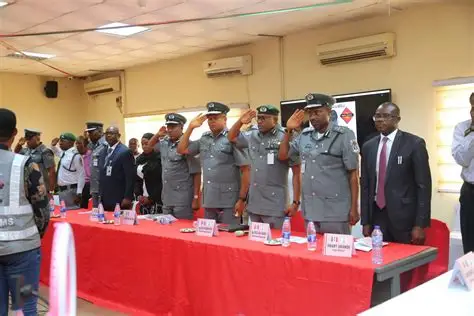
The United Kingdom and Nigeria are stepping up efforts to disrupt international drug trafficking networks as criminal groups continue to exploit global trade routes, technology and financial systems to move illicit substances across borders.
The renewed focus reflects growing concern over the increasingly sophisticated nature of transnational organised crime, with traffickers operating across multiple countries and combining drug smuggling with money laundering, fraud, human trafficking and other criminal activities. The UK’s National Crime Agency (NCA) describes drug trafficking as a major source of revenue for organised crime groups and says action against the trade can have a wider disruptive impact on other forms of serious crime. (National Crime Agency)
In Nigeria, the National Drug Law Enforcement Agency (NDLEA) has also intensified its intelligence-led operations against drug cartels, targeting major trafficking routes, warehouses, production facilities and international supply chains.
Nigeria steps up anti-drug operations
Nigeria’s campaign has increasingly focused on dismantling organised trafficking networks rather than simply intercepting individual couriers.
In June 2026, President Bola Tinubu said the country would strengthen the use of technology, intelligence, forensic science and international partnerships in the fight against illicit drugs. The NDLEA reported that it had arrested 29,262 suspected drug offenders, seized more than 5.3 million kilogrammes of illicit drugs valued at over ₦1.5 trillion and secured 5,225 convictions between 2025 and the first half of 2026. (The Guardian Nigeria)
The agency also said it had dismantled several transnational drug cartels and disrupted networks allegedly connected to international drug production and money laundering.
The scale of the operations underscores the increasingly international character of the drug trade. Nigeria serves not only as a destination for some illicit substances but also as a transit point in wider trafficking routes linking Africa, Europe, Asia and the Americas.
UK targets international supply chains
British authorities are similarly concentrating on the criminal organisations behind drug shipments rather than treating trafficking as an isolated street-level crime.
The NCA says organised crime groups involved in drug trafficking frequently participate in other serious offences, with proceeds from the illegal drug trade used to finance activities including firearms trafficking, modern slavery, organised immigration crime and money laundering. (National Crime Agency)
The agency has also warned that cocaine trafficking networks are becoming increasingly collaborative, with criminal organisations from different regions working together to move larger quantities of drugs while sharing transportation networks and reducing the impact of individual seizures. (National Crime Agency)
West Africa has emerged as an important part of some cocaine supply chains into Europe. According to the NCA, legitimate commercial and shipping links between Brazil and West Africa have created opportunities that organised crime groups can exploit to move cocaine across the Atlantic and onward to European markets. (National Crime Agency)
Greater emphasis on intelligence sharing
With traffickers operating across national boundaries, authorities in Nigeria and the UK increasingly recognise that arrests and seizures in one country may have limited impact unless they are accompanied by intelligence sharing and coordinated investigations elsewhere.
International law enforcement agencies have repeatedly demonstrated the value of cross-border cooperation in dismantling criminal networks. Europol, for instance, has previously coordinated operations involving Nigerian-linked criminal syndicates accused of drug smuggling, human trafficking and other serious offences. (Europol)
For Nigeria and the UK, stronger cooperation could involve the exchange of intelligence, financial investigations, joint investigations, capacity building and improved monitoring of high-risk shipments and trafficking routes.
Criminal networks adapting to enforcement
Despite increased seizures and arrests, authorities face a rapidly changing threat.
Traffickers are adopting new concealment methods, exploiting commercial shipping systems and using technology to communicate and coordinate operations. The NCA has warned that international cocaine networks are increasingly using new routes and methods, including sophisticated concealment techniques and greater cooperation between criminal organisations. (National Crime Agency)
Technology has also become a major component of the wider criminal economy. Authorities are increasingly concerned about the use of encrypted communications, digital financial services and other technologies that can make it harder to identify the individuals controlling trafficking operations.
The United Nations Office on Drugs and Crime has similarly warned that global drug markets are being transformed by technology, new types of drugs and instability, creating fresh opportunities for traffickers. (United Nations Office on Drugs and Crime)
Beyond arrests and seizures
Law enforcement officials maintain that tackling drug trafficking requires more than intercepting shipments.
Investigators must identify the financiers, organisers, logistics providers and money launderers who allow criminal networks to operate. Freezing criminal proceeds and disrupting financial channels can therefore be as important as seizing drugs.
Nigeria’s expanding focus on forensic investigations, financial intelligence and international partnerships reflects this broader approach. The government has also emphasised the need to address both the supply of illicit drugs and the demand that sustains the criminal market. (The Guardian Nigeria)
In the UK, authorities similarly regard drug trafficking as part of a wider organised-crime ecosystem. Disrupting the drug trade can therefore weaken criminal groups involved in several other offences at the same time. (National Crime Agency)
A continuing international challenge
The intensified cooperation between Nigeria and the UK comes as criminal networks become increasingly international in their operations.
Drugs can be produced in one continent, transported through several countries, concealed within legitimate cargo and ultimately sold thousands of kilometres away. The money generated can then be moved through complex financial networks before being reinvested in further criminal activities.
For Nigeria and the UK, the challenge will be to ensure that enforcement remains ahead of these evolving tactics.
With stronger intelligence sharing, coordinated investigations, financial tracking and technological capabilities, both countries are seeking to make it increasingly difficult for traffickers to exploit their borders and transport networks.
The renewed crackdown therefore represents not just a campaign against illegal drugs, but a broader effort to dismantle the criminal organisations and financial structures that sustain transnational organised crime.