

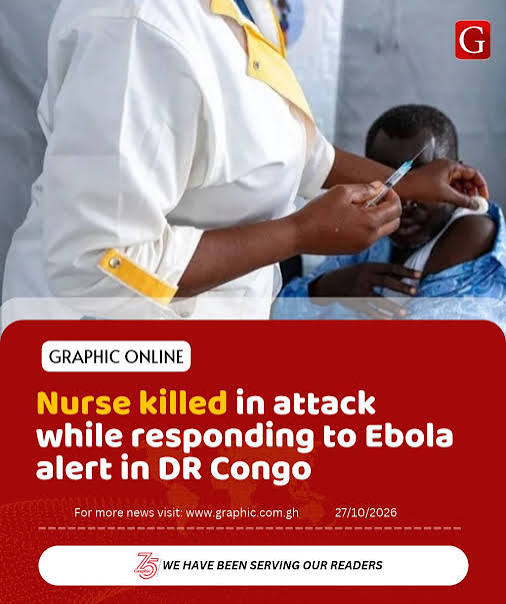
A nurse has been killed and another health worker seriously injured after they were attacked while responding to an Ebola alert in the Democratic Republic of the Congo (DR Congo).
The attack occurred in Bafwasende, a rural town in Tshopo Province in the eastern part of the country, amid ongoing efforts to contain a deadly Ebola outbreak.
According to reports, the health workers were attacked by local youths who allegedly accused them of spreading the virus and contaminating water sources. The nurse died at the scene before emergency assistance could reach him, while the injured health worker was taken for medical treatment.
The incident has drawn condemnation from the United Nations (UN) and the World Health Organisation (WHO), which called for the protection of health workers involved in the response to the outbreak.
Julien Harneis, the UN’s Senior Ebola Response Coordinator, condemned the killing and called for a thorough investigation into the circumstances surrounding the attack.
He also urged local communities to protect medical personnel and allow them to carry out their duties safely.
WHO Director-General Tedros Adhanom Ghebreyesus expressed condolences to the family and colleagues of the deceased nurse while wishing the injured worker a speedy recovery.
He stressed that healthcare workers must be able to perform their duties in safety and dignity, adding that medical personnel should never be targets of violence.
The killing comes as DR Congo continues to battle one of its deadliest Ebola outbreaks, with thousands of reported cases and deaths since the outbreak was declared in May 2026.
Health authorities have faced significant challenges in containing the disease, particularly in communities where misinformation, fear and distrust of public institutions have complicated efforts to educate residents and provide medical assistance.
In some areas, residents have reportedly questioned the existence of the disease or accused response teams of spreading it. Such beliefs have contributed to hostility towards health workers and other personnel involved in disease prevention.
The latest attack has raised fresh concerns about the safety of medical teams working in affected communities and the potential impact of violence on efforts to control the outbreak.
Health workers play a critical role in identifying suspected cases, tracing contacts, educating residents and ensuring that people who may have been exposed to the virus receive appropriate care.
Attacks against these personnel can delay emergency responses, discourage workers from entering affected areas and make it more difficult for authorities to identify and contain new infections.
Previous incidents in DR Congo have also involved attacks on health facilities and threats against Ebola response teams. These challenges have added pressure to an already strained healthcare system, particularly in remote communities with limited medical resources.
Ebola is a serious infectious disease that spreads through direct contact with the bodily fluids of an infected person or contaminated materials. Early detection, appropriate medical care, infection-prevention measures and community cooperation are essential to limiting transmission.
The current outbreak is caused by the Bundibugyo virus, a strain for which there is no approved vaccine, making surveillance and other public health measures particularly important.
The UN and WHO have called on communities to reject misinformation, cooperate with health authorities and allow medical personnel to carry out their work without fear of violence.
Meanwhile, the circumstances surrounding the nurse’s killing require further investigation, with authorities expected to establish responsibility for the attack and take appropriate action.
The incident serves as a reminder that protecting health workers is essential to safeguarding communities and strengthening efforts to contain the Ebola outbreak.