

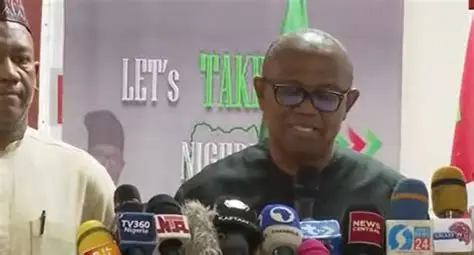
Presidential candidate of the New Democratic Congress (NDC), Peter Obi, has raised fresh concerns over the state of Nigeria’s democracy, accusing political actors and sections of the professional class of contributing to the weakening of the country’s electoral and judicial institutions.
Obi spoke on Tuesday at the 2026 Goodluck Jonathan Foundation (GJF) Democracy Dialogue held at the Ahmadu Bello International Conference Centre in Bauchi State.
The dialogue, themed “Beyond Elections: Can Political Parties and the Judiciary Save African Democracy?”, brought together political leaders, policymakers, jurists, civil society organisations, development partners and other stakeholders to examine the challenges confronting democracy across Africa.
In his goodwill message, the former Anambra State governor expressed concern over what he described as the declining integrity of Nigeria’s electoral system and judiciary, warning that the country was facing a serious democratic crisis.
Obi recalls experience at Court of Appeal
Obi recalled his experience at the Court of Appeal, where he said five judges whom he had never met delivered a judgment in his favour.
He used the experience to illustrate what he described as the importance of judicial independence and integrity in protecting democratic institutions.
“I went to Court of Appeal, five judges I never met gave judgment in my favour,” Obi said.
He, however, contrasted that experience with what he described as the deterioration of democratic values in Nigeria, particularly the increasing involvement of educated professionals in electoral malpractice.
The former governor questioned how professionals who should ordinarily strengthen democratic institutions could instead become involved in activities capable of undermining elections.
“So if you look at that and look at what is happening today in Nigeria, where professors are now aiding illiterates to rig election,” he said.
Criticism of lawmakers
Obi also turned his attention to lawmakers, accusing them of contributing to weaknesses in the electoral system through legislative decisions.
He specifically criticised what he described as the removal of forgery as an offence in electoral matters, arguing that such a development could weaken the integrity of elections and diminish accountability.
“Where our lawmakers have removed forgery as an offence in electoral matter. Our Senior Advocates of Nigeria are defending forgery,” he said.
The NDC candidate argued that laws governing elections must be designed to protect the sanctity of voters’ mandates and ensure that those who violate electoral rules are held accountable.
He maintained that the effectiveness of any democracy depends largely on the strength of its institutions and the willingness of public officials and professionals to uphold the law.
Lawyers and judicial accountability
Obi also raised questions about the role of legal practitioners in Nigeria’s democratic development.
While acknowledging the importance of lawyers and the judiciary in protecting constitutional rights, he expressed concern over situations where legal expertise could allegedly be used to defend actions that undermine electoral integrity.
He stressed that lawyers, particularly senior members of the profession, have a responsibility to protect the rule of law and strengthen public confidence in the justice system.
According to him, the judiciary must remain sufficiently independent to adjudicate electoral disputes without fear, favour or political influence.
He said citizens must have confidence that when their electoral mandates are challenged, the courts will provide an impartial avenue for justice.
Religious leaders also criticised
The former Anambra governor also expressed concern over the role of religious leaders in Nigeria’s political affairs.
He accused some religious leaders of failing to adequately hold politicians accountable when they are accused of wrongdoing.
“Our religious leaders are not praying for criminal politicians for blessing,” Obi said.
He argued that religious institutions have an important role to play in promoting morality, accountability and responsible leadership.
According to him, religious leaders should not remain silent when public officials engage in actions that undermine the interests of citizens or democratic institutions.
‘We have a crisis’
Obi said the combination of electoral malpractice, weakened accountability and concerns surrounding the judiciary had created a dangerous situation for Nigeria’s democracy.
“We have a crisis and above all our judges are not thinking for your mandate we stand, whether stolen or not,” he said.
He warned that democracy could not survive if citizens lost confidence in elections or became convinced that their votes would not determine who governs them.
The former governor therefore called for stronger institutions, credible elections and greater accountability from political leaders and other influential stakeholders.
Beyond elections
The focus of the GJF Democracy Dialogue was broader than the conduct of elections, with participants examining how political parties, courts and other democratic institutions can contribute to the survival and consolidation of democracy in Africa.
The theme of the dialogue reflected growing concerns across the continent over electoral disputes, weakening institutions, military interventions, constitutional manipulation and declining public confidence in democratic governance.
Obi argued that elections alone were not sufficient to sustain democracy, stressing the importance of institutions capable of protecting citizens’ rights and ensuring accountability between election cycles.
He urged Nigerians to resist the normalisation of electoral malpractice and defend institutions responsible for protecting democratic values.
Call for institutional reform
The former governor maintained that Nigeria needs a stronger commitment to institutional integrity if democracy is to deliver meaningful benefits to citizens.
He called for reforms that would strengthen the electoral process, protect judicial independence and ensure that political leaders are held accountable for their actions.
He also urged professionals, including academics, lawyers and religious leaders, to recognise their responsibilities in protecting democratic values rather than contributing to practices that weaken them.
According to Obi, Nigeria’s democratic future depends on the collective willingness of citizens and institutions to reject electoral manipulation and insist on transparency, accountability and respect for the rule of law.
His remarks at the democracy dialogue have further intensified the debate over the state of democratic governance in Nigeria, particularly the relationship between elections, political parties and the judiciary.
As the country moves towards the 2027 general elections, concerns over electoral credibility and institutional independence are expected to remain central to political discourse, with stakeholders facing renewed pressure to ensure that voters’ choices are respected and democratic institutions remain strong.