

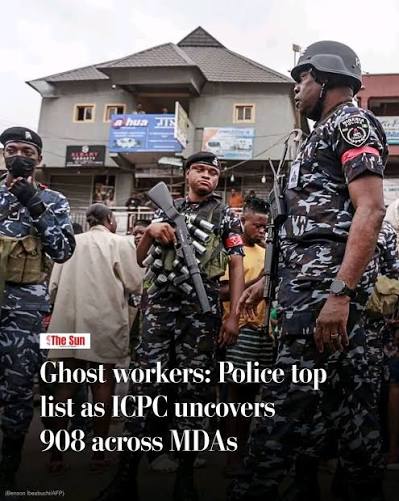
The Independent Corrupt Practices and Other Related Offences Commission (ICPC) has uncovered no fewer than 908 ghost workers across several government institutions, with the Nigeria Police Force reportedly accounting for the highest number of fraudulent entries on the payroll.
The revelation is part of ongoing efforts by the anti-corruption agency to sanitise the public sector and eliminate payroll fraud, which has long drained government resources.
Widespread Payroll Fraud Exposed
According to findings by the ICPC, the ghost workers were discovered during a comprehensive audit of personnel records and salary payments within various Ministries, Departments, and Agencies (MDAs). The exercise revealed discrepancies between actual staff strength and those listed on official payroll systems.
The Nigeria Police Force emerged as the most affected institution, raising concerns about internal controls and accountability mechanisms within one of the country’s largest public institutions.
Financial Implications
The presence of ghost workers on government payrolls translates into significant financial losses. Funds meant for legitimate employees are diverted into fraudulent accounts, undermining government spending and reducing resources available for critical services.
Analysts say the latest discovery highlights the urgent need for stronger verification systems and stricter monitoring of personnel records across all government agencies.
Steps Toward Reform
The Independent Corrupt Practices and Other Related Offences Commission has reiterated its commitment to tackling corruption through sustained audits and enforcement actions. Officials disclosed that measures are being taken to remove the identified ghost workers from the payroll and recover misappropriated funds.
There are also plans to collaborate with relevant agencies to strengthen payroll systems, including the adoption of biometric verification and integrated personnel databases to prevent future occurrences.
Accountability and Sanctions
The commission has indicated that investigations are ongoing to identify individuals responsible for inserting the ghost names into the system. Those found culpable may face prosecution in accordance with the law.
Anti-corruption advocates have welcomed the development, urging the government to ensure that culprits are held accountable to serve as a deterrent to others.
Renewed Focus on Transparency
The discovery underscores the broader challenge of corruption within Nigeria’s public sector. Experts stress that beyond removing ghost workers, there must be a sustained commitment to transparency, accountability, and institutional reform.
As the Independent Corrupt Practices and Other Related Offences Commission continues its crackdown, stakeholders hope the initiative will lead to more efficient use of public funds and restore confidence in government systems.