

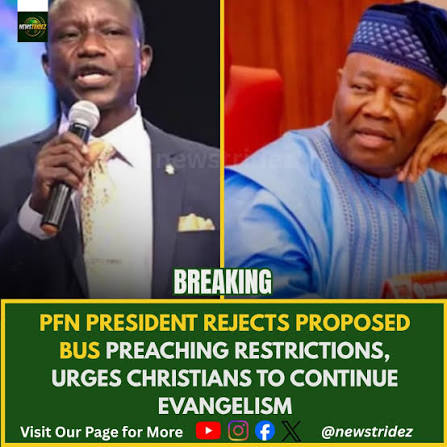
The President of the Pentecostal Fellowship of Nigeria (PFN) has declared that the organization will continue evangelizing in public spaces, including buses, despite a proposed ban aimed at restricting such activities. The stance sets the stage for a potential clash between religious groups and authorities seeking to regulate public conduct.
Speaking firmly on the issue, Bishop Francis Wale Oke emphasized that preaching is a core aspect of the Christian faith and cannot be curtailed by policy measures that, in his view, infringe on fundamental rights. He maintained that members of the fellowship are committed to spreading their message peacefully and responsibly, regardless of regulatory pressures.
The controversy stems from recent discussions around introducing restrictions on preaching in confined public spaces such as commercial buses, where some commuters have complained about noise, disruption, and the imposition of religious messages. Proponents of the proposed ban argue that such measures are necessary to protect passengers’ comfort and uphold order in public transportation systems.
However, Bishop Francis Wale Oke pushed back against the proposal, describing it as an overreach that could set a troubling precedent for limiting religious expression. He argued that Nigeria’s constitution guarantees freedom of religion and expression, and that these rights must be respected in both private and public spheres.
According to him, PFN members are mindful of their approach and are encouraged to preach with decorum, avoiding aggression or coercion. He added that the fellowship is open to dialogue with authorities to address concerns, but insisted that an outright ban would be unacceptable.
The issue has sparked mixed reactions among the public. While some citizens support the proposed restriction, citing the need for quieter and more neutral public spaces, others have defended the right of individuals to share their beliefs freely.
Legal experts note that any attempt to enforce such a ban could face constitutional challenges, particularly if it is perceived to disproportionately target a specific group or limit fundamental freedoms without sufficient justification.
As debates continue, the situation highlights the delicate balance between safeguarding individual rights and maintaining public order. For now, the PFN leadership remains resolute, signaling that evangelism in public spaces will continue even as discussions around regulation evolve.