

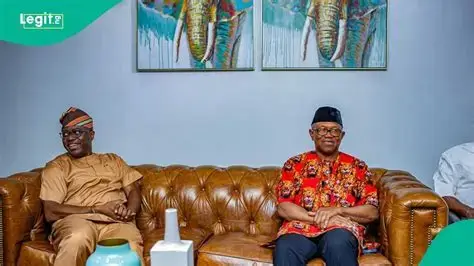
As Nigeria moves closer to the 2027 general elections, opposition forces are intensifying efforts to build a broader political coalition capable of challenging the ruling All Progressives Congress (APC), with Oyo State Governor and Allied Peoples Movement (APM) presidential candidate, Seyi Makinde, and former Anambra State Governor, Peter Obi, emerging as prominent voices in the campaign for a political “reset.”
The latest mobilisation took place in Abuja on Monday, September 7, 2026, during the inauguration of the APM presidential campaign office, where Makinde unveiled the “Reset Nigeria” agenda and called on Nigerians to participate actively in a national conversation about the country’s future.
The event brought together opposition figures from different political platforms, including Makinde, Obi, APM National Leader and Bauchi State Governor Bala Mohammed, former Niger State Governor Mu’azu Babangida Aliyu, and other political stakeholders.
The gathering underscored growing calls among opposition politicians for greater cooperation ahead of the 2027 presidential election, with some leaders advocating the eventual emergence of a single candidate who could present a stronger challenge to the ruling party.
Makinde: Nigeria Needs a Reset
Speaking at the event, Makinde said the country could not continue with the same approach to governance while expecting fundamentally different outcomes.
He argued that the “Reset Nigeria” initiative was designed to move political discussions away from personality-driven campaigns and towards issues affecting ordinary Nigerians.
According to him, the movement must not remain confined to politicians or political gatherings but should become a broader national conversation involving workers, traders, farmers, students, entrepreneurs and young Nigerians.
Makinde said the objective was to build a Nigeria where government decisions are transparent, public officials are accountable and national resources produce measurable benefits for citizens.
He also dismissed suggestions that his campaign was insignificant, recalling that similar doubts had surrounded his political journey before he became governor of Oyo State.
The governor maintained that political observers might underestimate individual candidates, but could not ignore millions of Nigerians seeking better governance and improved living conditions.
Opposition Unity Takes Centre Stage
One of the strongest messages from the Abuja gathering was the need for opposition parties to cooperate ahead of the 2027 election.
Peter Obi, who is contesting the presidency under the Nigeria Democratic Congress (NDC), said political differences should not prevent opposition leaders from working together for the country’s interest.
Obi stressed that the ultimate objective should be to allow Nigerians to freely choose their preferred candidate in a credible election.
He said whichever candidate eventually emerges victorious through a free, fair and credible process should receive the cooperation of other political actors to address the country’s challenges.
Obi also argued that political competition should not translate into personal hostility, insisting that politicians from different parties could disagree politically while still working towards national development.
Bala Mohammed Warns Against Underestimating Makinde
Bauchi State Governor and APM National Leader, Bala Mohammed, also used the occasion to warn political opponents against dismissing Makinde’s presidential ambition.
Mohammed described Makinde as an experienced administrator and resource manager, pointing to his record as governor of Oyo State.
He urged Nigerians to pay attention to the APM candidate’s campaign and the ideas being presented under the “Reset Nigeria” platform.
The APM leadership has positioned Makinde’s candidacy around issues including economic growth, security, accountability, competence and improved welfare.
The party has also said it intends to run an issue-based campaign focused on practical solutions rather than political bitterness, division or personal attacks.
Makinde Rejects Return to Fuel Subsidy
A major component of Makinde’s economic message is his position on petroleum pricing.
While some opposition politicians have called for changes to the current fuel-pricing regime, Makinde clarified that his proposal should not be interpreted as support for a return to the old fuel subsidy system.
Instead, he advocated a different approach in which Nigerian crude supplied to domestic refineries would reflect the country’s status as an oil-producing nation.
He questioned why crude produced in Nigeria should be priced for Nigerian refineries as though it had been imported from another country.
Makinde argued that Nigerians should receive a direct and measurable benefit from the country’s petroleum resources and called for greater transparency throughout the oil and gas value chain.
Call for Transparency in Oil Sector
According to the APM candidate, Nigerians should be able to understand how the final price of petroleum products is determined.
He called for transparency covering crude production, domestic crude allocation, refining, transportation, distribution, taxation and retail margins.
Makinde argued that rather than relying on opaque interventions after costs and inefficiencies have accumulated, benefits should be incorporated into the system from the beginning.
His position places petroleum-sector reform at the centre of his broader argument for greater accountability in the management of Nigeria’s natural resources.
Aliyu Calls for a Single Opposition Candidate
Former Niger State Governor Mu’azu Babangida Aliyu also called for closer cooperation among opposition parties ahead of the election.
Aliyu argued that insecurity, poverty and displacement had continued to undermine development across the country and that political actors needed to work together to address these challenges.
He said opposition leaders had already held meetings aimed at strengthening cooperation and suggested that discussions could eventually lead to the emergence of a common candidate.
The former governor maintained that a united opposition would have a better opportunity to challenge the ruling party in 2027.
A Broader Political Realignment
The latest development is part of a wider political realignment ahead of the 2027 elections.
Makinde formally declared his presidential ambition earlier in 2026 and has since positioned himself as one of the opposition figures seeking to build a coalition around an alternative political agenda.
Obi, meanwhile, remains another major opposition figure with a substantial political following after his 2023 presidential campaign.
Their appearance together in Abuja therefore carries political significance, particularly at a time when opposition parties are exploring ways to consolidate their strength and avoid splitting votes among multiple presidential candidates.
However, bringing together opposition parties with different structures, ideologies and presidential ambitions remains a major challenge.
The 2027 Battle Takes Shape
The 2027 presidential contest is gradually developing into a major political battle, with the ruling APC seeking another term while opposition parties attempt to create a viable alternative.
For Makinde and his allies, the “Reset Nigeria” agenda is intended to provide a platform for discussing how the country’s political and economic systems can be restructured.
For Obi and other opposition figures, the emphasis is increasingly on cooperation and ensuring that political competition produces a credible alternative for voters.
Whether the various opposition forces can overcome their differences and agree on a common strategy could become one of the defining issues of the 2027 election.
For now, Makinde is urging Nigerians to look beyond traditional political rivalries and participate in what he describes as a national conversation about the country’s future.
As campaigns gather momentum, the central question will be whether the opposition can transform its calls for unity into a coherent electoral alliance capable of challenging the APC at the ballot box.
With the “Reset Nigeria” message now taking centre stage, the 2027 election is already shaping up as a contest not only between political parties, but also between competing visions of how Nigeria should be governed and where the country should be headed.