

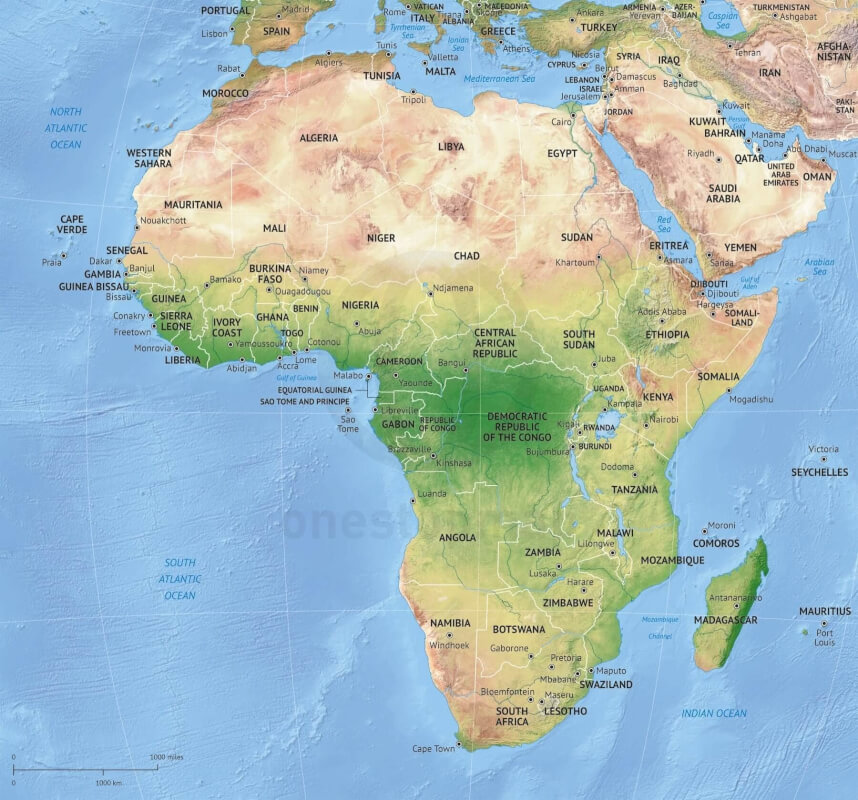
For centuries, the way the world has been drawn on maps has shaped how people understand geography, power and even the relative importance of nations and continents. Now, Africa is at the centre of a new conversation about how the world should be represented—and, more importantly, how the continent should define its place in the emerging global order.
The debate gained fresh international attention after the United Nations General Assembly endorsed a resolution supporting the use of the Equal Earth map projection, which presents the relative sizes of continents more accurately than the widely used Mercator projection. The resolution, championed by Togo and backed by African countries, was adopted on September 4, 2026, with 164 countries voting in favour.
The decision is not simply about cartography. For many African advocates, it is also about correcting a longstanding distortion in the way the continent is perceived.
A Different Picture of Africa
The Mercator projection, developed in the 16th century primarily for navigation, significantly exaggerates the size of territories located closer to the poles while making regions around the Equator appear smaller.
The consequence is particularly striking for Africa. On conventional Mercator maps, Greenland can appear comparable in size to Africa, even though Africa is roughly 14 times larger.
The Equal Earth projection provides a more realistic representation of Africa’s enormous geographical scale. While the UN resolution is not legally binding and does not prohibit the use of Mercator maps, it encourages governments, schools, media organisations and digital platforms to consider more accurate alternatives.
The symbolism is significant. Africa is not a small continent sitting at the margins of the world map. It is the world’s second-largest continent by land area, home to 54 countries and more than a billion people, with vast natural resources, enormous agricultural potential and a rapidly expanding consumer population.
From the Map to Global Power
The debate over the map comes at a time when Africa’s position in international affairs is itself changing.
The global system is moving away from the relatively unipolar period that followed the end of the Cold War and toward a more fragmented and competitive environment involving the United States, China, Russia, India, Europe and a growing group of middle powers.
African countries are increasingly attempting to avoid being locked into a choice between competing global powers. Instead, many governments are seeking relationships with multiple partners based on trade, investment, infrastructure, technology, security and national development priorities.
Research published in 2026 describes Africa as an increasingly strategic actor in a fragmenting international system, using diplomatic partnerships, multilateral institutions and South-South cooperation to increase its room for manoeuvre.
This approach reflects a broader desire for strategic autonomy—the ability of African states to make decisions based on their own interests rather than simply following the priorities of larger powers.
Africa Wants a Bigger Voice
The demand for greater representation is also visible in international institutions.
African governments have repeatedly argued that the continent’s representation in global decision-making structures does not reflect its population, number of countries or growing economic importance.
A 2026 Afrobarometer report found that 71 per cent of surveyed Africans believe African countries should have more influence in international decision-making bodies. The survey also found significant support for economic engagement with China, while many Africans continue to favour international trade and broader global integration.
This suggests that Africans are not necessarily calling for isolation from the international system. Instead, the demand is increasingly for a system in which Africa participates as an equal partner.
That distinction is important.
The continent does not simply want to be included in decisions made elsewhere. It increasingly wants to participate in making the decisions.
Resources and the New Geopolitical Competition
Africa’s strategic importance is also being reinforced by its natural resources.
The global transition toward renewable energy, electric vehicles, advanced technology and artificial intelligence has increased demand for critical minerals and other resources found across Africa.
Countries possessing important deposits of cobalt, copper, lithium, graphite, manganese, uranium and rare-earth-related resources are attracting greater attention from major economies.
This competition creates both opportunities and risks.
If African countries continue exporting raw materials without developing local processing and manufacturing capacity, much of the economic value generated by those resources could continue to accrue outside the continent.
But if African governments can strengthen industrial capacity, improve infrastructure and negotiate better investment agreements, the continent could capture a much larger share of the value chain.
This is one reason economic integration has become increasingly important.
AfCFTA and the Possibility of a Larger African Market
The African Continental Free Trade Area (AfCFTA) offers one of the continent’s biggest opportunities to strengthen its position in the global economy.
A more integrated African market could encourage companies to produce within Africa for African consumers rather than relying heavily on imported manufactured goods.
It could also give African governments greater bargaining power when negotiating trade and investment agreements with external partners.
However, integration will require more than signing agreements. Roads, railways, ports, electricity networks, digital infrastructure, payment systems and customs procedures must improve if goods and services are to move efficiently across borders.
Africa’s ability to influence the new world order will therefore depend not only on diplomacy but also on how successfully it builds its own economic strength.
The Challenge of Speaking With One Voice
Despite its enormous potential, Africa faces a major structural challenge: the continent is politically divided among 54 sovereign states with different national interests.
What benefits Nigeria may not always benefit Egypt. What Kenya wants may differ from the priorities of Algeria or South Africa. Smaller economies may also have different concerns from the continent’s larger economies.
The African Union provides an important platform for coordination, but translating continental declarations into coordinated action remains difficult.
This is why analysts increasingly emphasise stronger regional integration and institutions.
The African Development Bank, for instance, has argued that African countries must act collectively if they are to shape their future in an increasingly multipolar world. At the 2026 African Economic Conference, participants stressed stronger institutions, deeper regional integration and greater trade resilience as essential to expanding Africa’s geopolitical influence.
Africa’s Demographic Advantage
Africa’s future importance will also be driven by demographics.
By 2050, approximately one-quarter of the world’s population is projected to be African, while the continent’s urban population is expected to expand dramatically. Its growing population could create one of the world’s largest consumer and labour markets.
But population growth can become either an advantage or a challenge.
If African countries provide quality education, healthcare, jobs, digital access and productive industries, the continent’s young population could become one of its greatest sources of economic strength.
If governments fail to create opportunities, however, rapid population growth could intensify unemployment, migration pressures, insecurity and social instability.
The new world map, therefore, is not simply about showing Africa at the correct geographical scale. It is also about whether the continent can convert its size, population, resources and strategic location into genuine global influence.
A New Era of African Agency
For decades, Africa was often portrayed primarily as a recipient of foreign aid, investment and international policy.
That narrative is increasingly being challenged.
African governments and institutions are seeking greater control over their natural resources, stronger trade relationships within the continent and broader diplomatic partnerships outside it.
The objective is not necessarily to replace one external power with another. Instead, many African policymakers are pursuing a more flexible approach in which the continent engages with the United States, China, Europe, India, Russia, the Gulf states and other partners according to specific national and continental interests.
This approach is particularly relevant as the global system becomes more competitive.
Analysts increasingly describe the emerging international environment as multipolar or increasingly fragmented, creating greater room for middle and smaller powers to manoeuvre—but also exposing them to intensified competition among major powers.
The Meaning of the New Map
Ultimately, the debate over the world map carries a message that goes beyond geography.
A map can influence perception, and perception can influence politics.
For generations, distorted maps have contributed to a visual understanding of the world in which some regions appear disproportionately large and others appear smaller than they actually are. The new push for more accurate mapping is therefore being viewed by supporters as part of a broader effort to correct historical misconceptions.
But a more accurate map alone cannot change Africa’s position.
The real transformation will come from stronger economies, accountable institutions, improved infrastructure, technological innovation, regional integration and effective diplomacy.
Africa’s challenge is no longer simply to demand a seat at the table. It is to develop the economic and political strength required to influence what is decided at that table.
The new world map may show Africa in its true geographical proportions. The larger question now is whether Africa can also establish its true weight in global affairs.
The answer will depend on what African governments, institutions, businesses and citizens do with the opportunities presented by a rapidly changing world.
The map is changing. Africa’s place in the world is changing with it.