

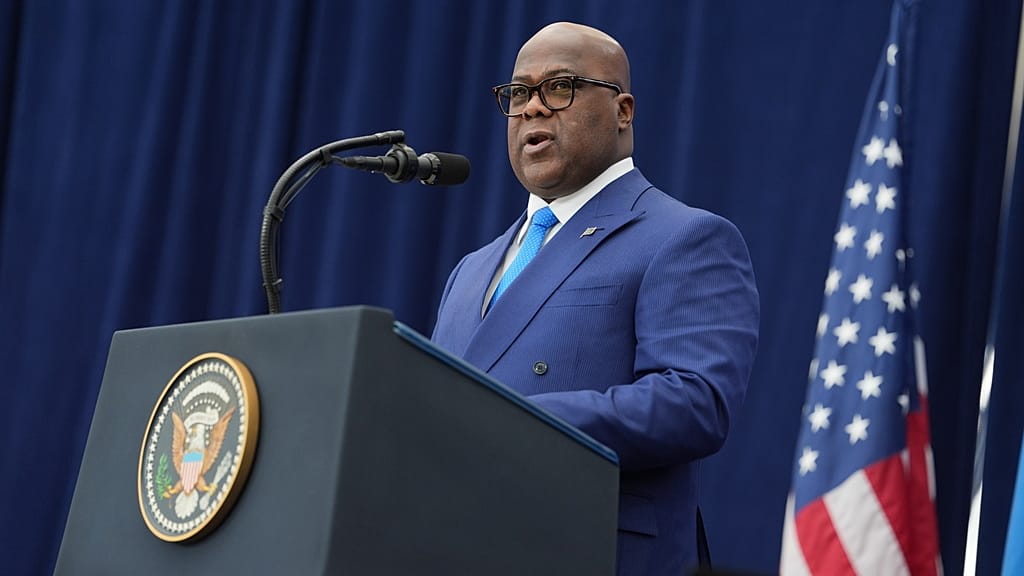
WASHINGTON/KINSHASA — A lawsuit filed in the United States has placed the Democratic Republic of Congo (DRC) under fresh international scrutiny, as Idaho‑based financial technology company PayServices accuses senior Congolese officials of attempted bribery and sabotage of a multimillion‑dollar modernization project.
The Allegations
According to documents seen by AFP, PayServices says it was invited in late 2023 to form a joint venture with the Congolese government aimed at revitalizing the country’s public banking system and digitizing the national economy. The company claims it accepted the agreement and invested more than $72 million in technology and services, under a contract stipulating that the Congolese state would pay $20 million within two weeks.
However, PayServices alleges that “several corrupt officials” — acting without the knowledge of President Félix Tshisekedi — conspired to demand bribes. Those named include the Minister of Public Enterprises, the Minister of Finance, and the Governor of the Central Bank. Close associates of Tshisekedi, including his chief of staff, are also mentioned.
When PayServices refused to pay, the company claims the officials sabotaged the agreement, breached the contract, and terminated the project. The lawsuit seeks $20 million in damages plus reimbursement of the $72 million investment.
Government Response
The Ministry of Public Enterprises rejected the accusations, calling them “devoid of any legal, budgetary, or accounting basis.” In its statement, the ministry accused PayServices of misrepresenting itself as a bank despite lacking the legal status of a financial institution.
“In this context, the authorities… have ended all administrative follow‑up of this case in order to protect the public treasury,” the ministry said.
Tshisekedi’s Position
PayServices claims that in May 2025, its executives secured a direct meeting with President Tshisekedi, who reportedly expressed shock at the alleged obstruction. The president’s office has not publicly commented on the lawsuit, but the case raises uncomfortable questions about governance and accountability in a country already struggling with corruption perceptions.
Broader Context: Corruption in the DRC
The DRC has long faced challenges with corruption and mismanagement of public resources. Transparency International consistently ranks the country among the lowest globally in terms of governance. Allegations of bribery and misuse of funds have dogged successive administrations, undermining investor confidence in one of Africa’s most resource‑rich nations.
The stakes are particularly high given the DRC’s vast mineral wealth, including cobalt and copper, which are critical to global supply chains for electric vehicles and renewable energy technologies. Efforts to modernize the financial system are seen as essential to ensuring transparency and attracting foreign investment.
International Implications
The lawsuit, filed in the United States, highlights the growing willingness of foreign companies to pursue legal remedies outside the DRC when disputes arise. If PayServices succeeds, the case could set a precedent for holding African governments accountable in international courts, potentially reshaping how foreign investors approach high‑risk markets.
It also places pressure on President Tshisekedi, who has sought to present himself as a reformer committed to fighting corruption and modernizing the economy. His administration’s denial of wrongdoing may reassure some supporters, but the involvement of senior officials in the allegations risks damaging his credibility abroad.
Political Ramifications
Domestically, the case could deepen tensions between Tshisekedi’s government and opposition figures who have long accused the ruling party of corruption. It may also complicate relations with international donors and financial institutions, who are closely monitoring governance reforms in the DRC.
For PayServices, the lawsuit represents not only an attempt to recover financial losses but also a test of whether international investors can trust the DRC’s business environment.
Outlook
As the case proceeds in US courts, the DRC faces renewed scrutiny over its governance and transparency. Whether the allegations prove true or not, the lawsuit underscores the fragility of investor confidence in the country and the urgent need for reforms to strengthen institutions, enforce contracts, and protect public resources.
For President Tshisekedi, the challenge will be to demonstrate that his administration can deliver on promises of modernization while tackling corruption at the highest levels. The outcome of this case may well shape perceptions of the DRC’s economic future for years to come.