

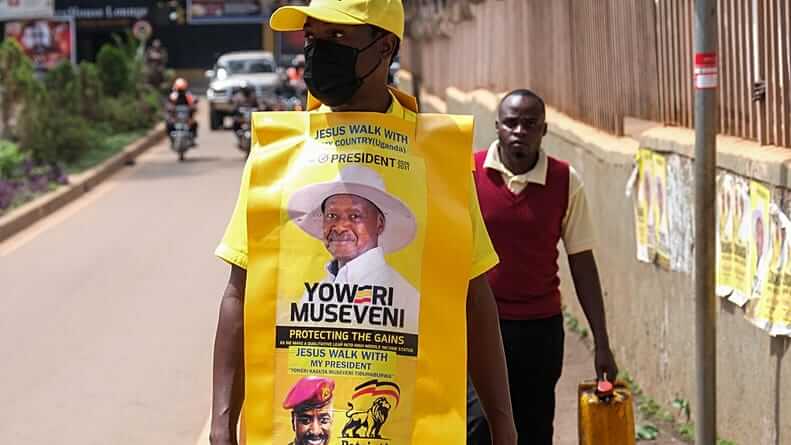
KAMPALA, Uganda — Uganda’s presidential election entered a tense phase on Thursday as President Yoweri Museveni, now 81 years old and already in power for four decades, cast his ballot in a contest that could extend his rule into a fifth decade. The vote, marred by delays, technical breakdowns, and a sweeping internet blackout, has drawn sharp criticism from opposition figures and international observers.
A Day of Disruption in Uganda
Polling stations across Kampala and Jinja opened late, with biometric machines malfunctioning and ballot boxes arriving hours behind schedule. In some areas, voting was forced to switch to manual verification, raising concerns about transparency. Opposition leaders accused the government of deliberately slowing the process to suppress turnout in strongholds of challenger Bobi Wine, a pop star turned politician. Authorities denied the allegations, attributing the problems to technical glitches.
The internet blackout, imposed earlier in the week, compounded frustrations. Voters struggled to verify information, opposition parties claimed their agents were arrested under cover of the blackout, and civil society groups warned that the shutdown undermined confidence in the electoral process.
Heavy Security Presence
The election unfolded under a massive police and army deployment. Security forces patrolled urban centers, determined to prevent anti‑government protests similar to those seen in neighboring Kenya and Tanzania. Rights groups reported that hundreds of Wine’s supporters had been arrested in the run‑up to polling day, echoing patterns from Uganda’s 2021 election when opposition rallies were violently dispersed.
Wine, 43, who styles himself the “ghetto president” after the slum communities where he grew up, has warned of mass protests if the vote is rigged. His campaign has faced what rights groups describe as “brutal repression”, including arrests, intimidation, and restrictions on rallies.
Museveni’s Enduring Grip
Despite the tension, Museveni remains the overwhelming favorite. His National Resistance Movement (NRM) dominates state institutions, the judiciary, and the security apparatus. Many Ugandans credit him with ending the chaos of the post‑independence years and ushering in relative stability. Under his leadership, Uganda’s economy grew steadily in the 1990s and early 2000s, and he remains popular among older voters who remember the violence of Idi Amin and Milton Obote.
Yet critics argue that Museveni has entrenched himself in power by removing constitutional term limits in 2005 and scrapping the presidential age cap in 2017. His opponents accuse him of weakening independent institutions, suppressing media freedom, and using patronage networks to maintain loyalty.
International Concerns
The United Nations expressed concern over the arrests of opposition supporters and the suspension of NGOs, including election monitors. Human Rights Watch denounced the internet blackout as a tool of repression. Western governments, while often critical of Museveni’s authoritarian tendencies, have historically tolerated his rule because of his cooperation with neoliberal reforms in the 1980s and his role as a partner in the US‑led war on terror, particularly through troop contributions in Somalia.
Voter Sentiment
On the ground, voter opinions remain divided. Supporters of Museveni praise him for maintaining peace and security, pointing to Uganda’s role as Africa’s largest host of refugees. “Peace and security in the country is very good. The party is well‑organised,” said Angee Abraham Lincoln, a 42‑year‑old voter in Kampala.
Wine’s supporters, however, see him as the face of change. His youthful energy and celebrity status have galvanized Uganda’s younger generation, who make up the majority of the population and have only known Museveni as president.
The Stakes
The outcome of this election will shape Uganda’s political trajectory for years to come. If Museveni secures a seventh term, he will cement his place among Africa’s longest‑serving leaders, alongside Cameroon’s Paul Biya and Equatorial Guinea’s Teodoro Obiang. For Wine and his supporters, the vote represents a chance — however slim — to break the cycle of entrenched leadership and open the door to democratic renewal.
Outlook
Official results are expected within 48 hours. Security forces remain on high alert, and opposition leaders have vowed to resist what they call “rigging.” Whether Uganda emerges from this election with renewed stability or deeper divisions will depend not only on the final tally but also on how both sides respond to the outcome.
For now, Ugandans wait anxiously, caught between the promise of continuity and the hope of change.