

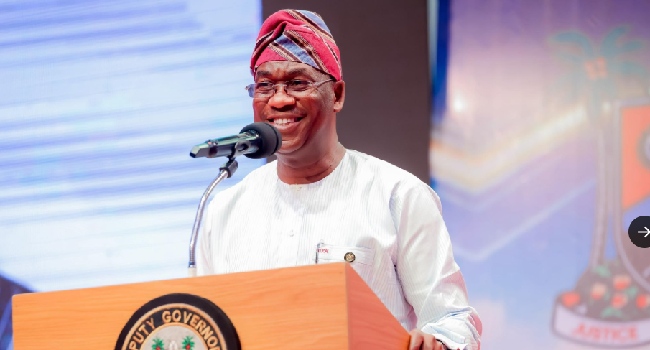
Lagos State Deputy Governor, Obafemi Hamzat, has clarified his controversial description of the state’s persistent traffic congestion as a “lifestyle”, saying the remark was taken out of context and was not intended to suggest that traffic gridlock should be accepted as desirable.
Hamzat came under criticism after he made the comment while speaking at PODFEST Naija, a gathering of storytellers, podcasters and other creative professionals in Lagos. During the event, he discussed how the city’s traffic, crowds and fast-paced environment have influenced its identity and contributed, in unexpected ways, to the creative industry.
“Anyone who has crossed Third Mainland Bridge at 6pm knows that Lagos traffic is not the problem; it is just a lifestyle,” Hamzat had said, adding that commuters often consume podcasts and other digital content while travelling through the city.
He also described traffic as an unexpected patron of the podcast industry, noting that residents travelling between areas such as Ojota and Obalende often use their time in transit to consume creative content.
The remarks generated reactions on social media, with some critics interpreting them as an indication that the government had accepted traffic congestion as a permanent feature of life in Lagos.
In a subsequent clarification, Hamzat said his comments were specifically made in the context of his discussion about Lagos, storytelling and the creative economy. He said he was describing the reality of commuting in the city rather than endorsing congestion or making a statement about road design and traffic management.
Hamzat questioned the interpretation of his remarks, arguing that some reactions had connected his statement to broader criticisms of the government’s handling of traffic.
He cited comments from individuals who had linked Lagos congestion to issues such as road design and productivity, and maintained that those issues were not the subject of his original statement.
The deputy governor said the clarification became necessary because he believed his words had been separated from the broader context of his address.
The controversy has also prompted a defence of Hamzat’s remarks from Olusesan Daini, Director of the New Media Directorate for the joint PBAT-KOH Lagos State Campaign Council. Daini said acknowledging that traffic had become part of daily life in Lagos was different from accepting congestion as an ideal situation.
Daini pointed to ongoing government efforts in areas including rail and water transportation, road construction, junction improvements, intelligent traffic management and traffic enforcement as measures aimed at improving mobility in the state.
During his original address, Hamzat also spoke extensively about Lagos’ creative sector. He said the city was increasingly telling its own story through podcasters, filmmakers, musicians, writers, designers, developers and entrepreneurs.
He encouraged creatives to develop sustainable business models, stressing that having a large audience alone was not enough to guarantee commercial success. He also urged creators to protect their intellectual property and build businesses around their work.
Hamzat further linked safety and freedom to the growth of the creative industry, arguing that people are better positioned to create and tell stories when they feel secure.
The deputy governor’s clarification comes amid continuing public discussion about traffic congestion, transportation infrastructure and mobility in Lagos, one of Nigeria’s most densely populated urban centres.
While Hamzat’s original comment focused on the cultural and creative dimensions of the city’s traffic experience, the subsequent reaction has shifted attention back to the wider challenges posed by congestion and the need for effective transportation solutions.
Make the article more conciseSharpen the headline and opening