

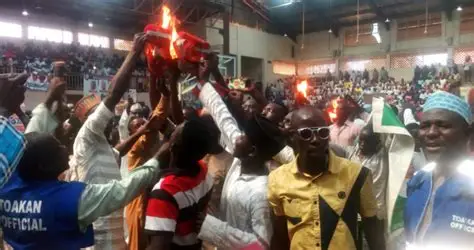
Some youths in Kiru Local Government Area of Kano State have reportedly expressed their displeasure with former Kano State Governor Rabiu Musa Kwankwaso’s decision to support Peter Obi ahead of the 2027 presidential election.
The youths reportedly demonstrated their opposition by setting fire to red caps associated with the Kwankwasiyya Movement, a political movement closely linked to the former governor. The development has generated fresh discussion about the political implications of the emerging alliance between Kwankwaso and Obi, particularly in Kano and other parts of northern Nigeria.
Kwankwaso, who has remained one of the most influential political figures in Kano politics, recently emerged as Obi’s running mate on the platform of the National Democratic Congress (NDC). The alliance represents a significant political realignment ahead of the 2027 general elections, bringing together Obi’s support base in the South and Kwankwaso’s political influence in the North.
Reports indicate that the youths in Kiru viewed Kwankwaso’s alignment with Obi as a departure from expectations within parts of his traditional political base. The burning of the red caps, therefore, was seen as a symbolic expression of dissatisfaction with the former governor’s latest political decision.
The red cap has for years been strongly identified with the Kwankwasiyya Movement and its supporters across Kano and beyond. It has become more than a political accessory, serving as a visible symbol of loyalty to Kwankwaso and the movement’s political ideology.
Kwankwaso, however, has defended his decision to work with Obi, explaining that his choice was influenced by considerations of national balance, equity and the need for political change. He said his experience since the 2023 elections had enabled him to understand Obi better and convinced him that both politicians could work together in the interest of Nigeria.
According to Kwankwaso, the alliance was also preceded by consultations with members of the Kwankwasiyya Movement, supporters of the New Nigeria People’s Party and members of the Obidient Movement. He said the consultations were aimed at building a political arrangement capable of attracting support from different regions of the country.
The former governor has also argued that the Obi-Kwankwaso ticket could bridge Nigeria’s regional and religious divisions by combining Obi’s influence in southern Nigeria with his own political reach in the North. He recently expressed confidence that the alliance could defeat President Bola Ahmed Tinubu in the 2027 presidential election.
Despite these explanations, the reported protest in Kiru highlights the potential challenges Kwankwaso could face in consolidating support for the new alliance among sections of his traditional supporters. The development also underscores the intensity of political realignment already taking place as politicians and supporters position themselves ahead of the 2027 elections.
Political loyalties in Kano have historically been highly organised around personalities, movements and grassroots structures. Consequently, any major change in alliance involving a prominent political figure such as Kwankwaso is likely to generate strong reactions among supporters and opponents alike.
The reported burning of the caps has therefore added another dimension to the growing political debate surrounding the Obi-Kwankwaso partnership. Whether the reaction remains limited to isolated protests or develops into a broader movement among former Kwankwasiyya supporters remains to be seen as the 2027 election approaches.
For now, the incident demonstrates that Kwankwaso’s decision to align with Obi has not gone unnoticed within his traditional political base, and the coming months are likely to reveal whether the new alliance can successfully transfer the former governor’s established northern political support into the broader coalition being assembled ahead of the 2027 presidential contest.