

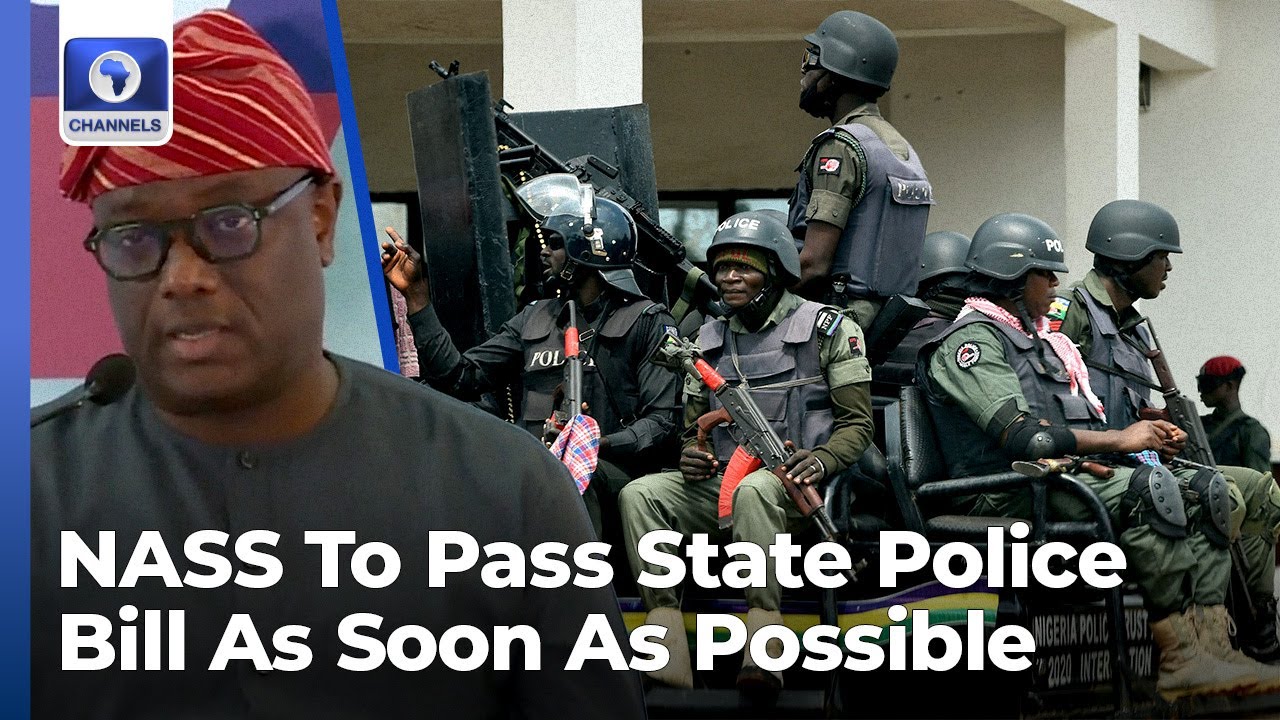
Nigeria moved a significant step closer to establishing state police on Wednesday after the Senate passed the Constitution Alteration Bill aimed at decentralising the country’s policing structure.
The development marks a major milestone in the long-running debate over security reform, as the country continues to grapple with terrorism, banditry, kidnapping, communal conflicts and other violent crimes.
With the Senate’s approval following the House of Representatives’ earlier endorsement of the proposal, attention now shifts to the 36 State Houses of Assembly. For the constitutional amendment to take effect, it must secure the support of at least 24 state legislatures before being transmitted to President Bola Tinubu for assent.
If enacted, the legislation would constitute one of the most consequential constitutional reforms since Nigeria’s return to democratic rule in 1999, fundamentally reshaping the nation’s security architecture.
Governors to Appoint State Police Commissioners
At the heart of the proposed reform is a provision empowering state governors to appoint Commissioners of Police for their respective states, subject to confirmation by the State Houses of Assembly.
The provision, contained in Clause 17 of the amendment bill, states that while the Federal Police Service will continue to be headed by the Inspector-General of Police, each State Police Service shall be led by a Commissioner of Police appointed by the governor and confirmed by the state legislature.
The arrangement effectively creates a dual policing system, allowing state police services to operate alongside the existing Nigeria Police Force.
Clear Division of Responsibilities
The Senate approved the bill after considering a report presented by the Deputy Senate President and Chairman of the Senate Committee on the Review of the Constitution, Barau Jibrin.
Leading debate on the legislation, Senate Leader Opeyemi Bamidele described the proposal as a carefully structured framework designed to balance local policing autonomy with national cohesion.
According to Bamidele, the Nigeria Police Force will retain responsibility for federal policing duties, while states that choose to establish police services will be empowered to manage local security matters.
Under the proposed framework, state police will be responsible for enforcing state laws, maintaining public safety and order, preventing and investigating local crimes, protecting lives and property, and performing other community-based policing functions.
The federal police, meanwhile, will continue to oversee national security responsibilities, including counter-terrorism operations, organised crime investigations, cybercrime enforcement, border security, arms trafficking, interstate criminal activities and the protection of federal institutions.
Conditions for Federal Intervention
The bill also outlines circumstances under which federal authorities may intervene in state policing matters.
According to Bamidele, such intervention would only occur in situations involving a breakdown of public order, the inability of a state police service to function effectively, serious violations of fundamental rights, established cases of electoral intimidation, or threats to national security.
Any federal intervention, he noted, would require written authorisation from the President and Commander-in-Chief and remain subject to Senate oversight and judicial review.
Safeguards Against Political Abuse
To address longstanding concerns that state governors could misuse state police for political purposes, lawmakers incorporated several safeguards into the amendment.
One key provision explicitly states that a State Commissioner of Police shall not arrest, detain, investigate or deploy force against any individual, political party or group merely for criticising the government, except in accordance with the law.
The measure is intended to protect political freedoms and prevent the use of state police as instruments of intimidation against opposition figures, critics or civil society groups.
In addition, the National Assembly will retain authority to establish minimum national standards governing recruitment, training, vetting, promotion, discipline, firearms management, use of force, complaints procedures, accountability mechanisms, data management and professional conduct.
Balancing Autonomy and Accountability
Bamidele said the framework seeks to balance local policing autonomy with national unity while ensuring accountability and operational effectiveness.
He argued that the bill preserves federal authority where necessary, protects constitutional rights and creates a modern policing structure capable of addressing contemporary security challenges.
Long-Standing Debate
The state police proposal has remained one of the most contentious constitutional issues since the advent of the Fourth Republic.
Supporters argue that Nigeria’s highly centralised policing structure is inadequate for a federation of more than 200 million people. They contend that locally recruited officers possess a deeper understanding of local languages, cultures and security dynamics, making intelligence gathering and crime prevention more effective.
Advocates also note that state governments already spend substantial resources supporting federal security agencies and should therefore have direct control over policing within their jurisdictions.
Critics, however, have consistently warned that state police could be exploited by powerful governors to intimidate political opponents, influence elections and suppress dissent.
Next Hurdle: State Assemblies
The significance of the Senate vote was reflected in the unusual voting process adopted during consideration of the bill. Following technical issues with the chamber’s electronic voting system, senators resorted to manual voting, with each lawmaker publicly declaring their position.
The proceedings were observed by several senior government officials, including Kaduna State Governor Uba Sani, Ogun State Governor Dapo Abiodun, Ondo State Governor Lucky Aiyedatiwa, and the President’s Chief of Staff, Femi Gbajabiamila.
The bill must now secure the approval of at least two-thirds of the 36 State Houses of Assembly before it can be transmitted to the President for assent.