

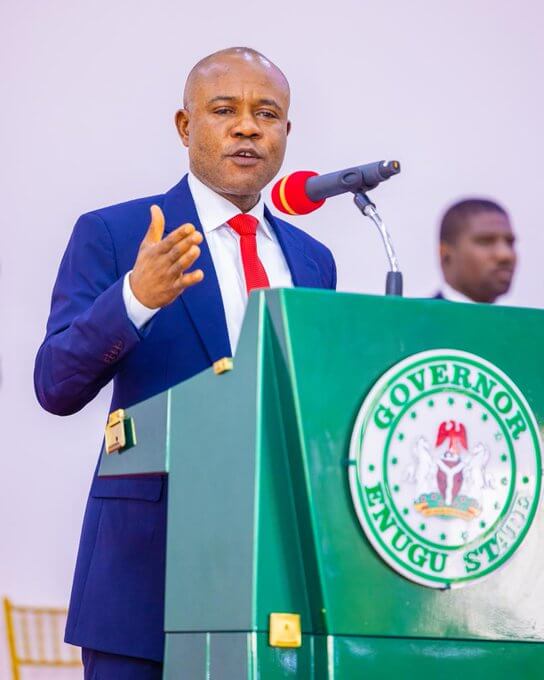
Long before I joined the team of Governor Peter Ndubuisi Mbah, I had publicly predicted that by the end of his eight-year tenure, there would be no basis for comparison between his administration and any other that had governed Enugu State — including the much-celebrated era of Sullivan Chime.
I was unequivocal. I stated clearly that Chime’s records would amount to “child’s play” by the time Barrister Mbah completed his tenure as governor.
At the time, I was not part of his administration, and that independence did not cloud my judgment. I could already see — and indeed feel — a decisive shift in the trajectory of governance in Enugu: a clear departure from what Ndi Enugu had previously experienced.
Some acquaintances, familiar with my history as an unflinching social critic, reached out privately. They sought reassurance that my position was not influenced by primordial sentiments, given that the Governor and I share Nkanu ancestry. They reminded me that I had often leaned “a little to the left of centre” and was rarely given to such unreserved praise of any government. My response was simple: I had seen something different.
Now, being part of the system has only reinforced that conviction. Governor Peter Ndubuisi Mbah, as a political leader, embodies uncommon leadership qualities — he is compassionate yet visionary, focused, deliberate, and results-driven.
He approaches governance with clarity of purpose and pursues his objectives with remarkable determination and discipline. This is not a knee-jerk administration; it is the product of careful preparation and strategic foresight. Governor Mbah clearly came into office with a comprehensive blueprint for building a modern, competitive society.
As an Enugu indigene, he understood what was missing — what the state and its people desired — and what was required to drive exponential growth across sectors.
Three years into his administration, it is evident that Governor Mbah has demonstrated both the capacity and the courage to govern effectively. He has broken barriers in service delivery and addressed critical needs across infrastructure, water supply, education, transportation, healthcare, and economic development.
Take industrial revival, for instance. No administration in the current democratic dispensation had successfully resuscitated moribund state-owned industries — until now. Within a year, Governor Mbah signaled his intent by reviving key assets such as Niger Gas, Hotel Presidential, Sunrise Flour Mills, and Enugu United Palm Products Limited.
In addition, his administration has established new ventures, including the $20 million Enugu Haier Industrial Park, a local manufacturing and assembly plant for laptops, smartphones, and renewable energy solutions.
Another landmark achievement is the transformation of the long-abandoned International Conference Centre (ICC), originally initiated during the Chimaroke Nnamani administration. For over two decades, it stood as a symbol of neglect. Today, it has been fully restored and repositioned, turning Enugu into a major conference destination in Nigeria, with the potential for global relevance.
Perhaps the most visible of Mbah’s innovations are the Smart Green Schools — modern, technology-driven educational facilities located in all 260 political wards. Designed as incubation hubs for future-ready learning, these schools integrate robotics, artificial intelligence, and digital tools into their curriculum, all offered free of charge. Pupils also benefit from free devices and daily meals, ensuring access and equity in education.
In the transport sector, the state-owned Enugu Air has emerged as a bold initiative, rapidly expanding its fleet and positioning the state within Nigeria’s aviation space. Complementing this are the introduction of CNG-powered buses and the construction of modern transport terminals, which have significantly improved mobility and reduced commuting costs.
Security, which was a major concern at the outset of the administration, has also seen remarkable improvement. Through a technology-driven Command and Control Centre and coordinated security strategies, the government has restored public confidence and freedom of movement across the state.
Healthcare delivery has been strengthened with the establishment of functional primary health centres in all wards and the near-completion of a 300-bed specialist hospital aimed at boosting medical tourism.
Road infrastructure has not been left out. The administration has undertaken extensive road rehabilitation and construction, opening up previously neglected communities and enhancing economic connectivity.
Across agriculture, industry, education, transport, and security, the Mbah administration has demonstrated a comprehensive and integrated approach to governance.
The slogan “Tomorrow Is Here” is not mere rhetoric; it reflects a tangible reality unfolding across Enugu State.
While critics may remain vocal, particularly on social media, the developments on the ground tell a compelling story — one of vision, execution, and measurable progress.
Indeed, Governor Peter Ndubuisi Mbah has emerged as a reference point for purposeful governance in Nigeria. His achievements are not cosmetic; they are real, verifiable, and impactful.
As I stated years ago, and now reiterate with even greater conviction: when the records of past administrations are placed side by side with his, the difference will be clear.
The story of Enugu under Mbah is one we will continue to tell — boldly, truthfully, and without hesitation.
Onyekwere, a member of the Nigerian Guild of Editors, is Special Adviser on Media to Governor Peter Ndubuisi Mbah.