

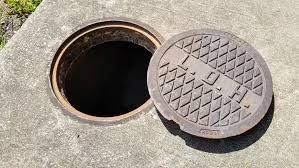
The Lagos State Government has raised concern over the alarming number of exposed manholes across the state, revealing that more than 6,000 have been left uncovered due to the theft of their covers.
The government warned that the situation poses a serious danger to motorists and pedestrians alike. However, it noted that significant progress has been made, with about 4,000 of the affected manholes already covered using fibre materials. Authorities also appealed to residents to take ownership of public infrastructure and help prevent vandalism and theft.
The Special Adviser to Governor Babajide Sanwo-Olu on Infrastructure, Olufemi Daramola, alongside his counterpart on Works, Dr. Adekunle Olayinka, disclosed this during a press briefing in Ikeja.
Daramola explained that the government has intensified stakeholder engagement efforts to curb vandalism, urging citizens to treat public assets as collective property.
“We currently have about 6,000 exposed manholes across the state. So far, 4,000 have been replaced with fibre covers, leaving about 2,000 yet to be addressed. Tackling this challenge requires a collective effort, and we are working closely with relevant ministries to strengthen enforcement,” he said.
On building safety, the General Manager of the Lagos State Materials Testing Laboratory, Olayinka Abdul, revealed that 52,969 concrete tests were conducted on buildings within the past year. She added that 4,649 compliance notices were issued, with only 46.9 percent adherence recorded.
She noted that the agency actively monitors construction activities through a digital tracking system, enabling timely intervention and sanctions against non-compliant developers to prevent building collapse.
Highlighting broader infrastructure achievements, the state government disclosed that it has completed 362 roads covering approximately 347 kilometres since 2019. These efforts form part of a wider strategy to enhance mobility, boost economic productivity, and improve public service delivery in Africa’s largest city.
According to Daramola, key projects completed during the period include the Opebi-Mende Link Bridge and its approach roads, Babajide Sanwo-Olu Road in Agege, Abaranje Road in Alimosho, as well as several major roads in Badagry and Ikorodu.
He added that a number of major projects are nearing completion and awaiting inauguration, including sections of the Eti-Osa–Lekki–Epe corridor, Gberigbe Road in Ikorodu, Aka-Kemberi Road in Ojo, Ijegun-Ijagemo Road, and Akesan-Igando Road in Alimosho.
“As part of our long-term vision, we are delivering resilient infrastructure that supports economic growth, improves connectivity, and enhances the quality of life for over 20 million Lagos residents,” Daramola stated.
He further disclosed that strategic projects such as the Igbogbo–Bola Ahmed Tinubu–Igbe Road, Agric–Isawo–Konu–Arepo Road, and the Lagos-Badagry carriageway are at advanced stages and expected to be inaugurated before the end of the current administration.
Beyond roads, the government is also investing heavily in public and social infrastructure. Responding to questions on the delayed opening of the Opebi-Mende Link Bridge, Daramola explained that work is ongoing on connecting roads, and the bridge will be opened once they are completed.
Also speaking, Olayinka said the administration has adopted an infrastructure-driven development model to address longstanding deficits while laying the foundation for sustainable economic growth.
He added that work is ongoing on major government facilities, including the Bola Ahmed Tinubu Administrative Complex and the Revenue House in Alausa, aimed at improving public service efficiency.
Olayinka further highlighted significant investments in healthcare infrastructure, including the construction of a 280-bed General Hospital in Ojo, a 150-bed Massey Children’s Hospital, and a 1,500-bed Psychiatric Hospital and Rehabilitation Centre in Ketu-Ejinrin, all of which are progressing steadily.