
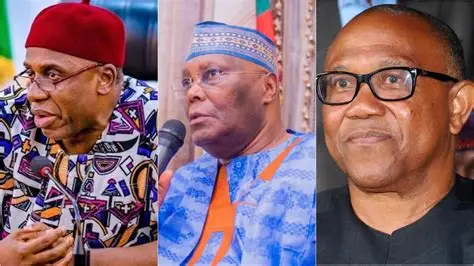

ADC Faces Deepening Rift as Top Figures Clash Over 2027 Presidential Ticket
The African Democratic Congress (ADC) is grappling with a major internal crisis after four of its most influential voices took conflicting public stands that risk splitting the party before it even nominates a candidate.
Within just a few days, former Vice President Atiku Abubakar, former Transport Minister Rotimi Amaechi, former Interior Minister Rauf Aregbesola, and the organised base of former Anambra Governor Peter Obi each released statements and declarations. Taken together, they show a party struggling with internal discord.¹
Atiku Holds Firm on 2027 Bid
Former Vice President Abubakar has insisted he will not withdraw for any aspirant ahead of the 2027 presidential election. He dismissed ongoing backchannel moves to convince him to step aside for a consensus arrangement within the ADC.²
Atiku, who has run for Nigeria’s presidency more than anyone else in the country’s democratic era, made it clear he will press ahead with his ambition despite pressure from inside or outside the party.
People close to the former vice president say he still believes he remains the opposition’s most formidable candidate. They cite his political network, funding capacity, and campaign experience as reasons he can run a serious nationwide contest.
His rejection of any step-down deal has frustrated several party stakeholders who argue that a unified opposition requires one of the leading names to make a concession for the greater good. At this point, Atiku has given no sign he is willing to be that person.
Amaechi Questions Atiku’s Age, Deepening Tensions
Rotimi Amaechi, former Rivers State governor and minister, went further by openly saying Abubakar is too old to seek the presidency in 2027.³
The remark, made without diplomatic cushioning, has caused ripples across the party. Within ADC circles, many view Amaechi’s comment as more than a personal view. They see it as a deliberate effort to undermine Atiku’s bid in the public arena before any primary is held.
Party insiders note that relations between the two men, never especially cordial, have worsened sharply in recent months as both position themselves for the party’s presidential ticket.
Amaechi has not hidden his own presidential interest and is believed to be building a support structure inside the ADC. His comments on age have angered Atiku’s allies. One source in the former vice president’s camp called the remarks “disrespectful and driven by politics.”
The back-and-forth has injected acrimony into the party’s internal dealings that observers believe will be hard to reverse.
Aregbesola and Obi Supporters Add Pressure
Former Interior Minister Rauf Aregbesola and the organised supporters of Peter Obi have also issued positions that complicate the party’s cohesion. While their statements differ in tone and demands, both camps have laid down markers that clash with Atiku’s and Amaechi’s postures, leaving the ADC with four divergent power centres.
Party officials worry that the public disagreements could harden into factions, making a credible primary process difficult. With no clear mediation framework yet announced, members fear the dispute may drag into the convention season and weaken the ADC’s standing against other parties.
Implications for 2027
The unfolding row highlights a broader challenge for opposition politics: balancing ambition with unity. Analysts say that unless the ADC leadership creates a transparent process and secures buy-in from all blocs, the party risks entering 2027 divided, with multiple candidates claiming legitimacy.
For now, each camp appears to be digging in. Atiku is leaning on his experience and structure. Amaechi is framing the contest around generational change. Aregbesola and Obi’s supporters are advancing their own red lines. How the ADC reconciles these will likely shape its relevance in the next election cycle.