

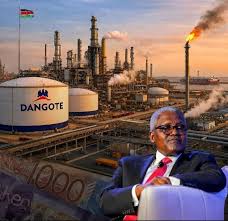
Ugandan President Yoweri Museveni has disclosed that he recently met with industrialist Aliko Dangote in Nakasero, where both parties discussed the development of a proposed regional oil refinery in East Africa.
Speaking after the meeting, Museveni reiterated that his administration’s core priority remains value addition, explaining Uganda’s long-standing reluctance to export crude oil without domestic refining capacity.
He argued that exporting raw crude allows foreign entities to capture most of the value from refined petroleum products, to the detriment of producing countries.
“Without refining our oil, it would neither make economic nor strategic sense to export crude while others benefit from the finished products,” Museveni said in a statement linked to a post shared on X on May 17, 2026.
The president expressed strong backing for a large-scale regional refinery, describing it as a critical step toward advancing African integration and shared prosperity.
He emphasised the need for East African countries to move beyond fragmented and individualistic economic approaches, urging deeper regional cooperation to execute large-scale projects capable of delivering broad-based benefits.
“We cannot continue to operate as fragmented and weak markets,” Museveni said. “If East Africa works together, such projects become more viable and beneficial to our people.”
He added that Uganda remains committed to its domestic energy agenda, noting that the country would pursue the regional refinery initiative alongside the development of its own refinery project in Hoima.
In recent years, Dangote has signalled interest in expanding refining and energy investments beyond Nigeria, with growing attention on East Africa as countries in the region seek to reduce reliance on imported petroleum products.
The proposed collaboration aligns with broader regional ambitions to develop integrated energy infrastructure that can serve multiple markets, rather than depend on fragmented national supply chains.
Within the region, Kenya remains a key strategic player, given its position as East Africa’s largest fuel import and logistics hub. The country hosts critical infrastructure, including the Port of Mombasa, extensive fuel storage facilities, and pipeline networks that supply petroleum products to neighbouring countries such as Uganda, Rwanda, South Sudan, and parts of eastern Democratic Republic of the Congo.