

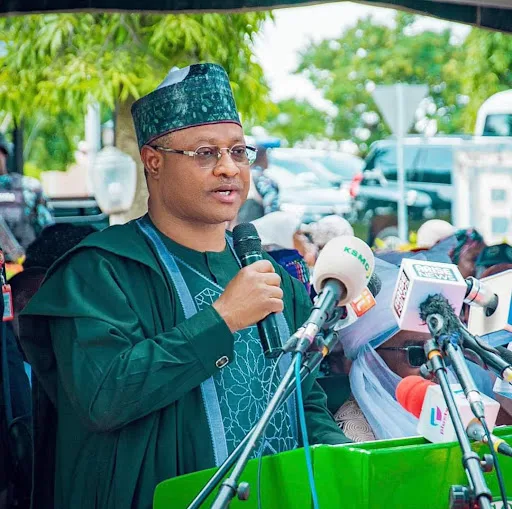
Four civil society organisations on Monday commended the administration of Governor Uba Sani for what they described as 12 landmark policies that have positioned Kaduna as a leading hub of governance innovation in Nigeria within just three years.
The commendation was contained in a joint press conference held at Arewa House in Kaduna by the Uba Sani Back2Back (USB2B) Movement, Uba Sani Legacy Projects Solidarity Assembly, Progressive Policy Advocacy Forum (PPAF), and the Renewed Hope Solidarity League (RNHoSL).
Addressing journalists, the Director of Strategic Communications of USB2B and convener of the coalition, Hadiza Mohammed, said the administration had distinguished itself through “first-of-their-kind interventions” spanning security, healthcare, education, agriculture, investment promotion, and human capital development.
She noted that Kaduna became the first state in Nigeria to establish a formal Disarmament, Demobilisation and Reintegration (DDR) structure, combining security operations with rehabilitation and recovery efforts—an approach aligned with recent state-level DDR initiatives aimed at tackling insecurity. (TheCable)
According to her, the initiative—implemented in collaboration with the Office of the National Security Adviser and the Kaduna Peace Committee—facilitated the release of over 500 captives without ransom and enabled the recovery of more than 500,000 hectares of farmland in Giwa, Birnin Gwari, and Kauru Local Government Areas.
On healthcare, the coalition highlighted Kaduna’s pioneering release of its 2025 Medical Residency Training Fund, alongside the approval of monthly hazard and training allowances ranging from ₦35,000 to ₦40,000 for doctors. It also noted the recruitment of 1,800 health workers to address staffing shortages in Primary Healthcare Centres.
The groups described these interventions as significant against the backdrop of Nigeria’s doctor-to-population gap, with fewer than 60,000 doctors serving over 220 million people.
In the area of mental health, they stated that Kaduna became the first Northern state to integrate mental health services into Primary Healthcare Centres and General Hospitals on a large scale. They added that the Kaduna Children Amplified Prevention System is set to reach 200,000 pupils across 253 schools in all 23 local government areas.
The coalition noted that the intervention is timely, given estimates that nearly 50 million Nigerians live with mental health conditions, while fewer than 300 psychiatrists are available nationwide.
They further disclosed that Kaduna has expanded community-based mental health and substance abuse intervention centres, now operating 23 Centres of Excellence—one in each local government area. While the Rigasa Centre has graduated 200 children from its literacy programme, the Kawo Centre is preparing to train 90 adolescents in jewellery and hardware-related skills.
The groups also described Kaduna’s Alternative-to-Incarceration Programme as groundbreaking, noting that the state has operationalised a structured framework for mental health and substance abuse recovery. They claimed it is the first of its kind in Nigeria and the only comprehensive model in Sub-Saharan Africa developed in partnership with the United Nations Office on Drugs and Crime (UNODC).
On disease prevention, the coalition highlighted the Hepatitis Elimination Programme, “Project 365,” which targets 620,000 residents across eight local government areas in Southern Kaduna for free screening, vaccination, and treatment. They noted that the initiative addresses a major public health concern, as an estimated 20 million Nigerians are living with Hepatitis B and C, with less than 10 per cent aware of their status.
In education, the administration was commended for reducing tuition fees in state-owned tertiary institutions by between 30 and 50 per cent. At Kaduna State University, fees were reduced from ₦150,000 to ₦105,000, while at Nuhu Bamalli Polytechnic, they dropped from ₦100,000 to ₦50,000—measures the coalition said have expanded access for students from low-income backgrounds.
The groups also credited the government with institutionalising structured investor aftercare services—the first of its kind in Northern Nigeria—aimed at supporting existing businesses through improved regulatory coordination, investment retention, and job creation.
On agriculture, the coalition said Kaduna has fully activated the Special Agro-Industrial Processing Zone (SAPZ) framework under an African Development Bank-backed programme valued at $538 million in its first phase across eight states. They noted that projections indicate the programme could boost agricultural productivity by over 60 per cent while reducing post-harvest losses.
They further stated that Kaduna is the first state in Northern Nigeria to establish an Agricultural Quality Assurance Framework, with an Agricultural Quality Assurance Centre being developed on a five-hectare site in partnership with Afreximbank and Bureau Veritas. The state’s agriculture budget, they added, was increased to ₦74.2 billion in the 2025 fiscal year to enhance export readiness and competitiveness.
The coalition also highlighted improvements in public health logistics, including upgraded medicine distribution systems through coordinated warehousing, digitisation, and last-mile delivery. No fewer than 255 Primary Healthcare Centres have reportedly been upgraded to Level Two status.
On skills development, they said Kaduna has become the first subnational government in Nigeria to commence construction of three Skills Acquisition Cities, expected to train 12,000 graduates in the first year and 24,000 in the second year across 13 vocational trades.
They also pointed to ongoing efforts to modernise Panteka Market—home to more than 38,000 artisans—into a major industrial and skills development hub.
Concluding, the coalition described the initiatives as evidence of a governance model anchored on security stabilisation, healthcare reform, educational access, agricultural transformation, industrial growth, and inclusive development.
They maintained that Governor Uba Sani’s administration has, within three years, positioned Kaduna as a reference point for policy innovation in Northern Nigeria and across the country, and called on citizens, development partners, stakeholders, and the media to sustain support for the state’s reform agenda.
The press conference was jointly endorsed by Hadiza Mohammed, Director of Strategic Communications and Convener of the Uba Sani Back2Back Movement; Hajiya Bilkisu Surajo, Acting Coordinator of the Uba Sani Legacy Projects Solidarity Assembly; Comrade Maxwell Bako Dogara, National Coordinator of the Progressive Policy Advocacy Forum; and Dr. Amina Yusuf Kwarbai, Secretary-General of the Renewed Hope Solidarity League.